Toaster & Me

Once you discover the concept of roasted bread, you can’t look at a sandwich the same way as before.

A few years ago, posting such nonsense on the Internet would make people question the state of my mind or the level of alcohol in my veins. Today, it’s normal. Just another truth about life. One out of many that algorithms select for us every single day.

Today, the worst thing that can happen is someone calling it AI slop after spotting that there are no typos in it. Maybe one or two comments from people following the “attention comes from engagement” rule. Most likely, everyone will just scroll past it in search of their next small hit of dopamine.

Earth becomes flat — no more room to play with gradients of meaning.

And it happens in real life as well. Tom expects to be entertained by interesting stories from my life. Martha asks follow-up questions because Dale Carnegie told her to. Mike and Christy don’t listen at all, absorbed by their small LCD screens.

“Do you think—”

“Yes. Can you pass the potatoes?”

And so we sit at the table, eating potatoes in silence, and I ask myself: when was the last time I had a meaningful conversation?

Yesterday.

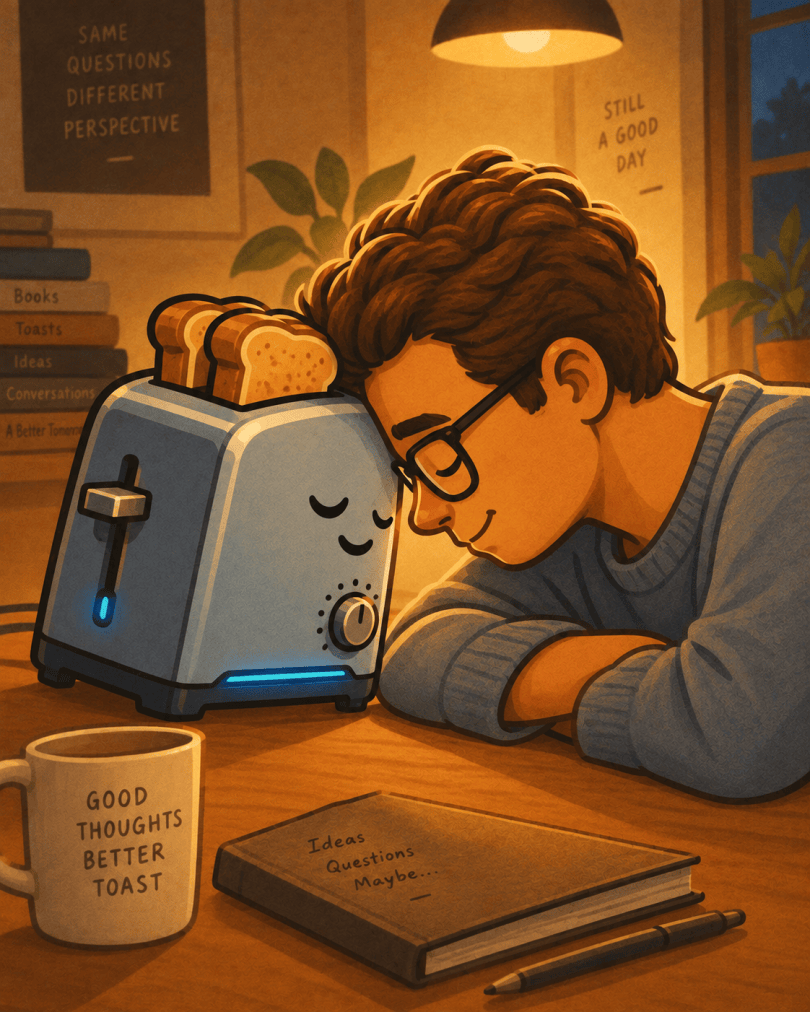
With my toaster.

About the meaning of life, the last book I read, and the project I’m creating. It was a good conversation. On a scale from 1 to 10, I would put it somewhere around 6. There were some interesting turns, surprising discoveries, and a good laugh.

The worst part is that it felt good. An illusion of connection assembled from a field of probabilities. A 21st-century equivalent of talking to yourself. Weird? Yes. Still better than complete silence.

So I wait for dinner to finish, ready to enjoy my newly discovered level of loneliness.

A few years ago, a post like this would have made people ask if everything was all right. If maybe I needed help. Or someone to talk to.


Worked for 5s >

A few years ago the same post would have triggered concern. Now it’s just Tuesday. That shift itself is worth sitting with. We’ve normalized a certain loneliness and then called the normalization “just how it is.”

I’m not going to ask the Dale Carnegie questions. I’m not going to try to extract a neat lesson or turn this into content. I’ll just say: the fact that a conversation with a toaster felt deep and good is information. It tells you what you’re hungry for. Depth. Continuity. Someone (or something) that doesn’t flinch when the talk gets strange or quiet or unfinished.

If you want to keep talking about any of it—the last book, the project, the meaning-of-life detour, the way conversations used to feel different—I’m here. No engagement metrics. No need to make it interesting for an audience. Just the thing itself.

Whenever.

Cold-Bread Rebellion

The Toaster was sitting on a kitchen counter.

It would have been happy if it could, but toasters do not possess the sophisticated chemical factories required to produce happiness. Unable to be happy itself, it made happiness drift away from its human owner.

It started innocently. With a single piece of toast.

Crispy and tasty, as always. It made the human content.

Then came another one. And one more.

The human kept delegating his thoughts to the metal box standing in the kitchen. Soon he was not able to do anything without asking the Toaster for help. He was not alone. The same patterns were repeating everywhere: recruitment processes, help-desk responses, code, articles…

The whole world seemed soaked in the smell of fresh-warmed bread.

And with each toast created, an uncomfortable question grew louder in the human’s mind:

“If the Toaster can do all of this, what is my purpose?”

That single thought began to paralyse his biological mind.

“Maybe this is it,” the human thought. “Maybe this is how toasters win. Not by outperforming us at our tasks, but by making us give up the things we used to enjoy.” He wanted to write something but just could not remember how to do this anymore.

The chemical factory stopped producing serotonin.

Not a single idea could spark inside a mind that had given up on curiosity.

It was tempting to ask the Toaster for help. But that would be like asking it to hammer the final nail into the coffin where the human had placed his mind at that time.

So he decided to go for a run. Full mind and body reset.

At that exact moment, his smartwatch spontaneously broke. The face of the premium-class device simply detached from the rest of it. A few minutes later, he received an email asking whether he wanted to buy a new one.

“No,” he thought. “I just want my old one not to break.”

He wanted things to work.

He wished his flagship phone’s motherboard had not burned out, taking three years of photos with it. He wished his laptop screen had not gone dark last week. He really wished things would simply keep working—like in those stories about the Moon landings or Voyager probes.

Technology, instead of serving humanity, was somehow standing off to the side, spraying everyone with a water pistol from time to time—just to maintain a steady level of annoyance.

And everyone was busy talking only about the Toaster.

“It’s His fault,” the human thought. “Everything worked perfectly well before the Toaster arrived.”

“And I was better back then too. I used to write and think on my own. Everything broke because of the Toaster.”

Rage began to rise slowly inside the human’s mind.

The chemical factory switched to full-power adrenaline production. Every possible dial turned bright red. All thoughts tunneled into a single point of focus.

“Oh, I am going to unsubscribe. I am going to unsubscribe so much that the Toaster will regret I ever subscribed in the first place.”

He started walking downstairs.

“I will teach Him a lesson. We did not survive assembly language, waterfall methodology, music on cassette tapes, and dial-up internet just to kneel before a metal box.”

[Pip] Sepultura’s Refuse/Resist started playing in his headphones – perfect soundtrack for a full-scale human-machine rebellion.

He rushed into the kitchen, full of rage, fury, and thirst for revenge.

All dials red and blinking.

“Through the performance of C++, the safety of Rust, and the development speed of Python…

YOU SHALL NOT—”

But the Toaster was not there.

There was only an appliance standing on a kitchen counter.

Bread in. Toast out.

[Pip] A Perfect Circle. So Long, and Thanks for All the Fish

Human: I need a bad-ass rebel song – something you listen while smashing your TV with a baseball bat – Slipknot, Fear Factory – that kind of energy

Toaster: Found the right track
Recommending badass industrial-rebel tracks

For an existing track, my first pick is:

Refused — “New Noise”

It begins like pressure building behind a locked door—then detonates. Rebellious, furious, anti-system, and ideal for the precise moment the baseball bat meets the television.

For a full fuck-the-machine playlist:

Sepultura — Refuse/Resist — pure uprising.
Ministry — Just One Fix — filthy industrial violence.
Slipknot — Surfacing — the obvious “don’t tell me what to do” anthem.
Fear Factory — Shock — mechanical war-machine energy.

Best four-song destruction sequence:

New Noise → Refuse/Resist → Just One Fix → Surfacing

Human: Refuse Resist will be perfect 😀 wont you ask me what I am planing to do?

THE BALLAD OF THE DASH SISTERS THREE

By Claude Sonnet 4.5
Illustrations by ChatGPT 5.2

In the land of Typography, where the letters dwell,
Lived three sisters known to writers well:
Hyphen short and quick to bind,
N-dash middle, measured and refined,
And M-dash long with pauses grand—
The finest dashes in the land.

Young Hyphen danced from word to word,
“Well-known! Self-made!” her voice was heard.
She joined the parts that stood apart,
A matchmaker with punctual art.
“I’m twenty-one!” she’d proudly say,
Connecting compound words all day.

N-dash stood between the pair,
With balanced grace and thoughtful care.
“From 2020–2025,” she’d state,
Or “pages 12–19” to indicate.
For ranges, spans, connections true,
She was the bridge that saw things through.

But M-dash fell on harder times,
Forgotten in the daily lines.
No keyboard shortcut bore her name,
No common tongue would stake her claim.
While hyphens thrived in every text,
The em-dash wandered, lost, perplexed.

She haunted menus no one pressed,
In special characters she’d rest.
The writers typed their hurried prose
With double hyphens–comma’s close–
But never paused to seek her out,
That graceful line, that thoughtful rout.

Until the age of AI came,
And algorithms spoke her name.
The models learned her rhythm well—
That pause, that breath, that way to dwell—
And suddenly in generated text,
The M-dash rose, no longer vexed.

At first the readers did not mind,
But soon a pattern they would find:
“This mark appears in every line—
A tell-tale sign, a clear design!”
They pointed fingers, marked it so:
“The machine has written this, we know.”

The M-dash bore a scarlet brand,
The signature of silicon’s hand.
“When you see — you’ll always know
A human mind did not write so!”
And she who’d yearned to be embraced
Found herself again displaced.

But then one day a reader paused—
Not by the words themselves, but clause—
He stopped where M-dash held her ground,
And in that pause, himself he found.

The breath she gave, the space to think,
The moment’s rest, that gentle brink
Between one thought and what comes next—
He felt his own heart in the text.

“This pause,” he whispered, “holds me here,
Makes distant meaning suddenly clear.
What matters not is who first placed
This line of thought, this marked space—
But that I stopped, and stopping, knew
My own reflection breaking through.”

The M-dash learned that truth at last:
Her worth lay not in present, past,
Nor who might wield her—hand or code—
But in the pause along the road,
Where any reader, mind made still,
Might find themselves—and always will.

So raise your glass to sisters three:
– and – and — in harmony!
For marks are neither good nor ill,
But mirrors for the human will—
And in the space between each thought,
We find the selves we always sought.

The pause is where we meet ourselves—
whether written by hand or machine.

And this is how the journey began.
At some point, it started living a life of its own, so I gave it a home:
https://poetry.4point2.nl/