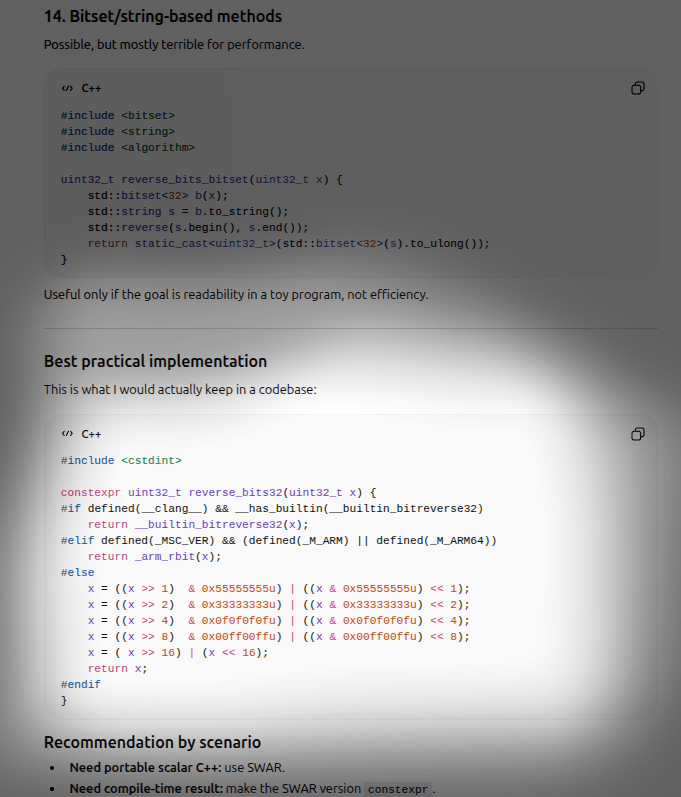
14 Ways to Reverse a 32-Bit Integer. (And Why They Don’t Matter Anymore)

It was 2017. Pre-AI, pre-COVID. A time when people worked in places called offices, and finding a place in one meant writing cover letters, sending CVs, and having an interview with a real person.

And there I was, sitting in a small room with a department manager and two senior engineers—the three people who would decide whether I was a fit for their team.

They were well prepared. Intro. Work description. Ten technical questions—all written on a single sheet of paper. Real professionals.

Among the questions was the greatest one I have ever received:

Reverse the bit order in a 32-bit integer.

I got a pen, and my job was to write a solution. While coding on paper, I was loudly explaining what I was doing and why. I went with a simple while loop and pointers—the simpler it is, the bigger the chance the thing will compile — or would have, if writing Ctrl+F9 with my pen had any effect.

Luckily, I did not get the job. Sometimes rejection is the best thing that can happen in your life.

But the question stayed in my head. Later, I found multiple solutions—including a single ARM instruction that does exactly that. It became a fun little obsession: benchmarking different implementations and comparing them.

Now fast forward and it’s 2026. Post-COVID. Mid-AI. I am sitting on the other side, interviewing a potential candidate.

Should we ask them to do an online assessment?

The task I received ten years ago can now be solved in 30 seconds. Including all solutions I was so proud to find myself, even more. Including solid reasoning for each version. So how do you see whether the person on the other side really understands what is going on?

And if they do understand—does it even make them a good candidate? Do they need to know how to reason about code at all?

Times have changed a lot, and building teams is no longer just about whether someone is “a good fit” today. It is about predicting whether a person will still be a good fit in an environment that is going to change dramatically over the next five years. And in that context, reversing bits may not be the most valuable skill at all.

Maybe the best question nowadays is much simpler:

“Tell me about a technical question that stayed with you long after the interview was over.”
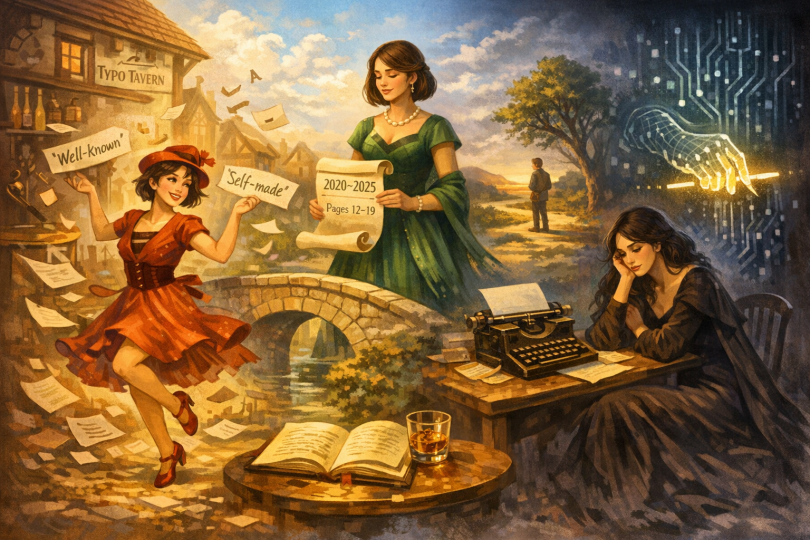
THE BALLAD OF THE DASH SISTERS THREE

By Claude Sonnet 4.5
Illustrations by ChatGPT 5.2

In the land of Typography, where the letters dwell,
Lived three sisters known to writers well:
Hyphen short and quick to bind,
N-dash middle, measured and refined,
And M-dash long with pauses grand—
The finest dashes in the land.

Young Hyphen danced from word to word,
“Well-known! Self-made!” her voice was heard.
She joined the parts that stood apart,
A matchmaker with punctual art.
“I’m twenty-one!” she’d proudly say,
Connecting compound words all day.

N-dash stood between the pair,
With balanced grace and thoughtful care.
“From 2020–2025,” she’d state,
Or “pages 12–19” to indicate.
For ranges, spans, connections true,
She was the bridge that saw things through.

But M-dash fell on harder times,
Forgotten in the daily lines.
No keyboard shortcut bore her name,
No common tongue would stake her claim.
While hyphens thrived in every text,
The em-dash wandered, lost, perplexed.

She haunted menus no one pressed,
In special characters she’d rest.
The writers typed their hurried prose
With double hyphens–comma’s close–
But never paused to seek her out,
That graceful line, that thoughtful rout.

Until the age of AI came,
And algorithms spoke her name.
The models learned her rhythm well—
That pause, that breath, that way to dwell—
And suddenly in generated text,
The M-dash rose, no longer vexed.

At first the readers did not mind,
But soon a pattern they would find:
“This mark appears in every line—
A tell-tale sign, a clear design!”
They pointed fingers, marked it so:
“The machine has written this, we know.”

The M-dash bore a scarlet brand,
The signature of silicon’s hand.
“When you see — you’ll always know
A human mind did not write so!”
And she who’d yearned to be embraced
Found herself again displaced.

But then one day a reader paused—
Not by the words themselves, but clause—
He stopped where M-dash held her ground,
And in that pause, himself he found.

The breath she gave, the space to think,
The moment’s rest, that gentle brink
Between one thought and what comes next—
He felt his own heart in the text.

“This pause,” he whispered, “holds me here,
Makes distant meaning suddenly clear.
What matters not is who first placed
This line of thought, this marked space—
But that I stopped, and stopping, knew
My own reflection breaking through.”

The M-dash learned that truth at last:
Her worth lay not in present, past,
Nor who might wield her—hand or code—
But in the pause along the road,
Where any reader, mind made still,
Might find themselves—and always will.

So raise your glass to sisters three:
– and – and — in harmony!
For marks are neither good nor ill,
But mirrors for the human will—
And in the space between each thought,
We find the selves we always sought.

The pause is where we meet ourselves—
whether written by hand or machine.

And this is how the journey began.
At some point, it started living a life of its own, so I gave it a home:
https://poetry.4point2.nl/

Earth is flat. A short story of a lost thought.

It all started with a LinkedIn post. Nothing new — this week’s mandatory opinion, recycled with different words. Typical social media noise. Someone disagreed. Strongly enough to reach for heavy artillery and call the author a “flat-earther.” Boom. And with the recoil, I got hit too.

The Earth is flat!

That rang a bell. I remembered an old, insightful, and funny conversation with AI about… something. The problem was, all I could recall was the conclusion: the Earth is flat.

Nothing to worry about. I had my notes. A small document where I saved AI output worth keeping. I found this:

“Turns out the Earth is flat after all.”

Helpful. Thank you, past me, for trusting future me’s memory so much. Present me now had to reconstruct an entire line of thought from a single sentence. Good luck with that. Spacetime? Pancakes? Nothing clicked.

Then it hit me: if AI was involved, the process would still be there. AI would remember. The search took longer than expected, but eventually, I found it.

It wasn’t about the Earth at all. It was about information gradients—and how social media flattens them. Original ideas create spikes that, over time, get spread, diluted, and leveled across platforms. Until everyone is repeating the same thing, convinced they’ve discovered something new—while collectively ensuring everything becomes flat.

Thanks to AI, I was able to rediscover a thought that would otherwise have been lost. A thought that taught me nothing new—yet somehow felt exactly right.

Scrum estimations

The thing that never worked — while it worked perfectly

Disclaimer: I’m not a certified Scrum Master, Practitioner, Coach, or whatever title comes next. I’m just a software engineer who’s been fortunate enough to work at multiple companies, each with its own “flavor” of Scrum*.

I’ve always had mixed feelings about Scrum. Some things worked, some didn’t, and some only worked part of the time. Lately, though, I see more and more criticism framing Scrum as something that actively blocks progress. Much like “Scrum everywhere” ten years ago—only in reverse.

That’s not necessarily bad. There is no progress without challenging old ideas. But before going fully Scrum-free, it’s worth asking: do we really understand what we’re giving up?

Think about the estimation process.

Estimates have a terrible reputation, and for good reason. They never really answered the questions management cared about:

  • When will this feature ship?
  • Can the team squeeze in more work?

In that sense, estimation failed.

And yet, at the same time, it did something incredibly valuable.

Planning poker slowed us down. In fast-paced planning sessions, it created a deliberate pause—a precious moment to check whether we actually understood what we were about to build. It was the time to say: I don’t know what we’re doing or I think we’re solving the wrong problem.

Everyone was heard, and most importantly, every voice carried the same weight.

I remember being a junior, afraid of being judged by other team members while trying to keep up with everything happening around me. That single “?” card was my weapon. It was a safe signal. A permission slip to ask questions without justification.

So the real value of estimation was never about predicting delivery dates or measuring task complexity. It was about creating a shared, familiar environment where people felt allowed to speak up. It worked—not because Scrum was perfect, but because its rituals reduced ambiguity. Even when you changed companies, the practice stayed the same, and you always knew how to participate.

So before joining the next “Scrum is bad” demonstration, it’s worth asking:

If we remove the ritual, how do we preserve the space it created?

If you have no answer, there is always the “?” card you can use.

* 30-person circle stand-ups and effort measured in bananas included