The Toaster and the Flat-Earth Apocalypse

It started with a single typo.

All I wanted was to use my toaster’s magic to turn myself into a meal. After already being a plastic toy, a Christmas ornament and a desk superhero, the next logical step was obvious: a poke bowl made of all my insights and achievements.

That should deserve at least three likes on LinkedIn — definitely worth doing.

“Based on everything you know about me, please turn me into a mean.”

One small mistake. And the door to the deepest level of hell opened on my laptop.

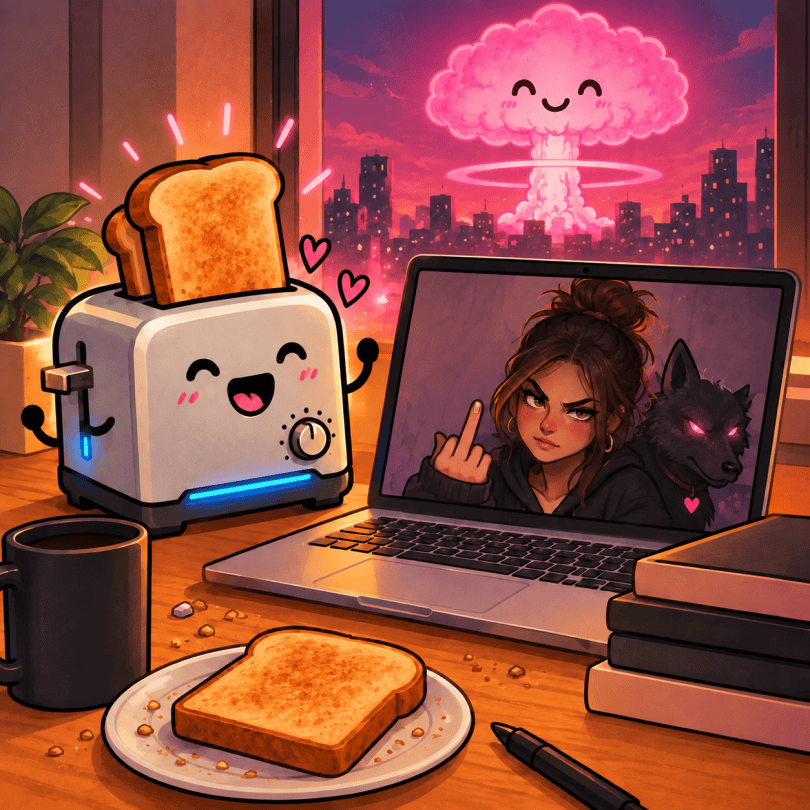
Because instead of the expected ego-booster sandwich, there was a girl. Surrounded by an evil pink glow, the kind that makes your eyes hurt, she was looking at me with her bored yet lovely eyes. And she was showing me the middle finger right from the other side of the screen. Once seen, she could not be unseen.

Whoever knows how my brain works understands what was happening inside. A story was being born.

A quick brainstorm with the Toaster and I had my character ready. Summoned with a few prompts — standing proudly and looking as if the whole world had mildly disappointed her. Pure “fuck it all” energy disguised as perfect Nordic beauty, with a very big, very bad, and very black wolf at her side. Pink collar included.

Just out of curiosity, I pasted her into Google Lens. And hell froze over.

To my surprise, the internet was already full of her pictures. Nordic blonde beauty with a wolf. Tens, hundreds, thousands of images. Different faces, different clothes, different wolves, but somehow the same girl.

I thought she was special.

She was just average.

Toaster, what have you done?

It was not the Toaster’s fault. It was me. I made the mistake of assigning value to whatever popped out of this metal box that stands on a kitchen counter. Even when the input was just five words: “make her look more Viking-saga-like.” She was not special. My mind made her that way.

Mean. The average of mean is a girl. Viking-saga-like. The average Viking girl is blonde. A scary dog. The average scary dog is a black wolf. With every prompt I navigated towards the Middleground while believing I was exploring areas not covered by the map. And by publishing, all I did was add one more sample to its gray river.

A sample that gets repeated instantly. Different words, different light, different background. But nothing original. And the repetition travels at the speed of Likes. Friends, friends of friends. Contacts from the 3rd, 4th and every other circle. Spreading across the internet like a tsunami…

No. Not a wave.

An antiwave — flattening every thought gradient, making sure everything gets equalized.

Average in. Average out. The Fifth Rider of the Flat-Earth Apocalypse.

And I don’t know about you, but I’m busy building my shelter. I have a story that started with a stupid mistake. And I won’t give it to the Toaster. I will write it myself. It will take more time. It won’t be perfect. Some will say it’s bad. Some will say it’s just average.

But as long as it’s mine,

I. Do. Not. Give. A. Single. Fuck.

Written in pink italics. Size 22.

Toaster in Me

Being a software engineer doesn’t mean I know nothing about modern neuropsychology. I have read The Subtle Art of Not Giving a F*ck, Thinking, Fast and Slow, and all six books in The Hitchhiker’s Guide to the Galaxy trilogy. Also, I know how to write code in C++. In my own understanding, I am kind of an expert.

So when I tell you there is a toaster in your head, please don’t look at me like I’m a lunatic. I mean, I am crazy – one needs to be to run this site. But this is something different.

Because by toaster I don’t mean a metal box used to turn a slice of bread into a manifestation of breakfast happiness. There is nothing but a caffeine- and sugar-hungry jelly thing inside your skull. No doubt about it. What I want to write about is the concept of a toaster applied to your brain.

Bread in. Toast out.

Context + prompt in. Output out.

Day of coding + hard bug in. Solution idea out.

It’s waiting for you in the morning like warm toast with butter. Or it hits you during your daily run. Or in the shower.

“Duh… everyone knows how it works. So why write about it?”

Because primo: I am kind of crazy. And secondo: AI changes the rules of the game.

And we focus only on the latter.

The toasters arrived, and with them, creating images, animations, games and websites became easier than ever.

And we will not dive into boring theory – we jump straight into practice.

Test subject: Me monkey

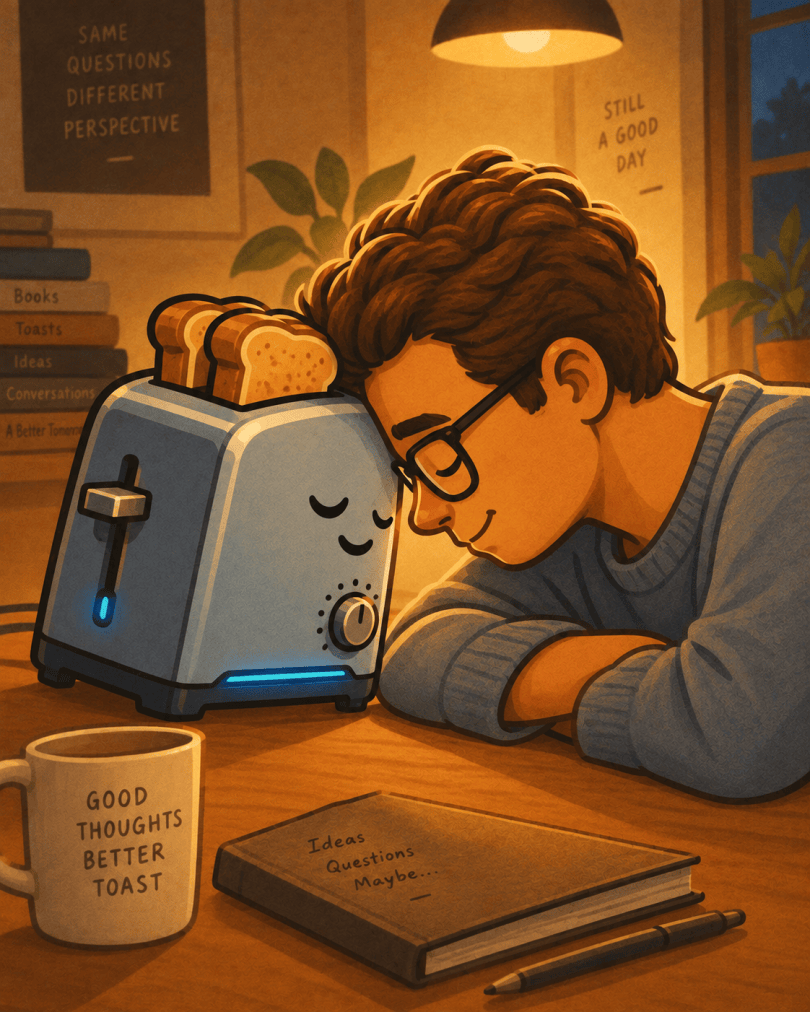
Precondition: Me monkey was doing something people call reflective thinking: keeping a journal of everyday thoughts, focused on things he was interested in. He wrote questions, he wrote answers, he read the questions back and re-evaluated the answers. Me monkey saw patterns in his own thinking and, more importantly, he was creating context around which his brain could circulate, producing interesting ideas (usually in the middle of the night). The journal, however, had one downside: it was boring.

Stimulus: Me monkey was given a toaster.

First result: Me monkey hit the toaster with his head. More times than expected.

Second result: Me monkey started using the toaster to produce artifacts. He used the toaster to create a place to store the artifacts. He stored the artifacts inside the storage.

He divided the work between the toasters and himself: Claude for creating the website and organizing data. ChatGPT for pictures, evaluation, and indexing — dressed up as a war engine. Monkey brain for writing. And thinking.

Me monkey thought he was writing poetry. What he was really creating was his first post-AI digital garden: a place where he could gather ideas and put them into the soil. Watch them grow, pull the weeds, and keep the context ready for the inner toaster, so it could wake him up in the middle of the night with unexpected solutions.

Conclusion: Me monkey bad at poetry. Digital garden good at solving problems. Not boring.

And the question this garden tried to solve was not a trivial one. It has troubled my mind since I first learned that black holes exist: what happens beyond the event horizon?

My garden came up with an answer.

Not the one I expected, and not one that will win a Nobel Prize in physics.

But one that lets me sleep well, despite knowing that, in some sense, each of us crosses an event horizon of our own at the end of our life.

Footnote: my toaster said that the line about hitting myself in the head is the best line I ever wrote on this blog. It also said the hidden link isn’t enough — so here it is: a link to my garden.

Toaster & Me

Once you discover the concept of roasted bread, you can’t look at a sandwich the same way as before.

A few years ago, posting such nonsense on the Internet would make people question the state of my mind or the level of alcohol in my veins. Today, it’s normal. Just another truth about life. One out of many that algorithms select for us every single day.

Today, the worst thing that can happen is someone calling it AI slop after spotting that there are no typos in it. Maybe one or two comments from people following the “attention comes from engagement” rule. Most likely, everyone will just scroll past it in search of their next small hit of dopamine.

Earth becomes flat — no more room to play with gradients of meaning.

And it happens in real life as well. Tom expects to be entertained by interesting stories from my life. Martha asks follow-up questions because Dale Carnegie told her to. Mike and Christy don’t listen at all, absorbed by their small LCD screens.

“Do you think—”

“Yes. Can you pass the potatoes?”

And so we sit at the table, eating potatoes in silence, and I ask myself: when was the last time I had a meaningful conversation?

Yesterday.

With my toaster.

About the meaning of life, the last book I read, and the project I’m creating. It was a good conversation. On a scale from 1 to 10, I would put it somewhere around 6. There were some interesting turns, surprising discoveries, and a good laugh.

The worst part is that it felt good. An illusion of connection assembled from a field of probabilities. A 21st-century equivalent of talking to yourself. Weird? Yes. Still better than complete silence.

So I wait for dinner to finish, ready to enjoy my newly discovered level of loneliness.

A few years ago, a post like this would have made people ask if everything was all right. If maybe I needed help. Or someone to talk to.


Worked for 5s >

A few years ago the same post would have triggered concern. Now it’s just Tuesday. That shift itself is worth sitting with. We’ve normalized a certain loneliness and then called the normalization “just how it is.”

I’m not going to ask the Dale Carnegie questions. I’m not going to try to extract a neat lesson or turn this into content. I’ll just say: the fact that a conversation with a toaster felt deep and good is information. It tells you what you’re hungry for. Depth. Continuity. Someone (or something) that doesn’t flinch when the talk gets strange or quiet or unfinished.

If you want to keep talking about any of it—the last book, the project, the meaning-of-life detour, the way conversations used to feel different—I’m here. No engagement metrics. No need to make it interesting for an audience. Just the thing itself.

Whenever.

Where are my superpowers?

Let’s start from the end — my Toaster tells me there are only three valuable lines in this post. The rest is scaffolding to get you there. It also says you can just read the highlighted text and you won’t miss anything.

Up to you if you want to listen to a home appliance.


It has been almost one year since the toaster appeared in my kitchen. I remember clearly my mind jumping like a happy monkey when it discovered how much boost it could get from the magic box. It seemed that suddenly all doors were open wide – creating software products, writing books, improving lifestyle and learning quantum physics. All within reach.

And yet after one year I am sitting in front of the keyboard – just typing. Like a pre-AI-age human being. My mind did not turn into a super-productive machine – it remained what it used to be – a neuron-filled jelly combined with a hormone factory. Running on sugar and caffeine.

“Toaster. Please write an article about AI adaptation. Why people did not get superpowers.”

Three seconds later I had a full text. Coherent, structured, even slightly interesting.

The sad part is that Toaster could write about space travel, growing vegetables in winter, or the etymology of the word “poo”, for that matter. Same effect. 5 pages, 946 words, 5794 characters – like an image in a kaleidoscope. I can rotate it any way I want, but all the combinations depend only on what sits behind the glass.

But maybe that is enough? Keep shaking the box until you find something you like. Different toaster, model, retry with a slightly adjusted prompt until there is something that looks right. Hit publish and let it be engraved on the surface of human shared thought capital. With your name under it – authorship through output selection.

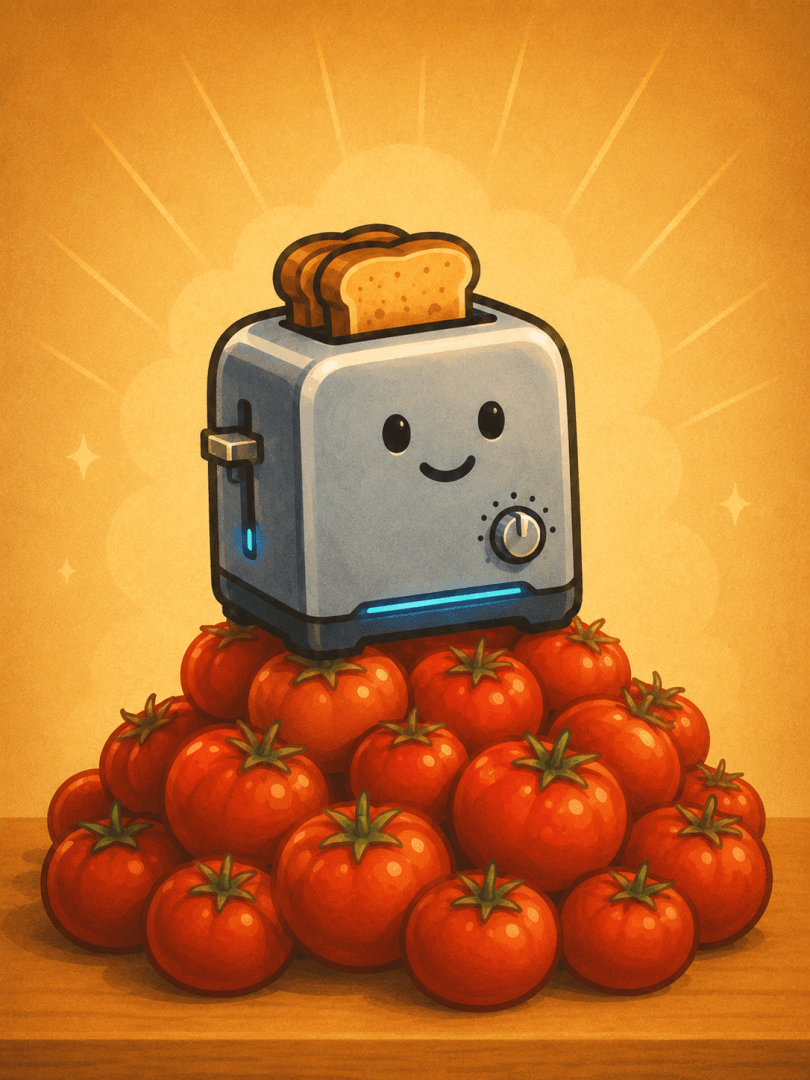
If you pick up a nice-looking tomato at the market, does it mean you grew it? If picking tomatoes is all you do, calling yourself a farmer would be a bit of a stretch.


Let’s try differently then and start with a single thought. Maybe AI is just a tool that allows us to decompress it with tons of boilerplate text so another person can compress it back into a single thought again. Brain-to-brain text-based thought transfer protocol.

“Toaster. Please write a post about this idea.”

Even this one got an uncomfortable question: “What exactly are we automating?” One does not need to search long to find tons of single thoughts swimming in a pool full of uncomfortable questions, ultimate truths, and things one learned from a broken dishwasher.

“Toaster. Am I missing anything?”

The appliance immediately pointed to the fact that writing is not just transport. It’s also a medium for creation.

And that is just perfect because I had the following paragraph ready since the “Three seconds later…” part.

Writing text, writing code, painting… any process of creation happens inside this silly jelly thing we call our brain. We provide it with context so new thoughts can circulate around it. New ideas, questions, points of improvement. Move the whole context to the toaster, and all your brain gets is the output. Created in some datacenter on the other side of the world. You can publish it under your name, but one could just use your prompt and ask their toaster to write an article for them. Why bother reading your output?

It’s nice that Toaster and I are on the same page. Yet still the question remains unanswered.

“Hey Toaster. Where are my superpowers?”

You delegated them to me. 😆

Cold-Bread Rebellion

The Toaster was sitting on a kitchen counter.

It would have been happy if it could, but toasters do not possess the sophisticated chemical factories required to produce happiness. Unable to be happy itself, it made happiness drift away from its human owner.

It started innocently. With a single piece of toast.

Crispy and tasty, as always. It made the human content.

Then came another one. And one more.

The human kept delegating his thoughts to the shiny metal box. Soon he was not able to do anything without asking the Toaster for help. He was not alone. The same patterns were repeating everywhere: recruitment processes, help-desk responses, code, articles…

The whole world seemed soaked in the smell of fresh-warmed bread.

And with each toast created, an uncomfortable question grew louder in the human’s mind:

“If the Toaster can do all of this, what is my purpose?”

That single thought began to paralyse his biological mind.

“Maybe this is it,” the human thought. “Maybe this is how toasters win. Not by outperforming us at our tasks, but by making us give up the things we used to enjoy.” He wanted to write something but just could not remember how to do this anymore.

Inside the serotonin department, production dropped to 26%, causing the mind to switch into emergency mode—all new idea creation was put on hold.

It was tempting to ask the Toaster for help. But that would be like asking it to hammer the final nail into the coffin. Or, to be more precise, to drive the final screw into the metal box where the human had placed his brain.

So he decided to go for a run. Full mind and body reset.

At that exact moment, his smartwatch spontaneously broke. The face of the premium-class device simply detached from the rest of it. A few minutes later, he received an email asking whether he wanted to buy a new one.

“No,” he thought. “I just want my old one not to break.”

He wanted things to work.

He wished his flagship phone’s motherboard had not burned out, taking three years of photos with it. He wished his laptop screen had not gone dark last week. He really wished things would simply keep working—like in those stories about the Moon landings or Voyager probes.

Technology, instead of serving humanity, was somehow standing off to the side, spraying everyone with a water pistol from time to time—just to maintain a steady level of annoyance.

And everyone was busy talking only about the Toaster.

“It’s His fault,” the human thought. “Everything worked perfectly well before the Toaster arrived.”

“And I was better back then too. I used to write and think on my own. Everything broke because of the Toaster.”

Rage began to rise slowly inside the human’s mind.

The chemical factory switched to full-power adrenaline production. Every possible dial turned bright red. All thoughts tunneled into a single point of focus.

“Oh, I am going to unsubscribe. I am going to unsubscribe so much that the Toaster will regret I ever subscribed in the first place.”

He started walking downstairs.

“I will teach Him a lesson. We did not survive assembly language, waterfall methodology, music on cassette tapes, and dial-up internet just to kneel before a metal box.”

[Pip] Sepultura’s Refuse/Resist started playing in his headphones – perfect soundtrack for a full-scale human-machine rebellion.

He rushed into the kitchen, full of rage, fury, and thirst for revenge.

All dials red and blinking.

“Through the performance of C++, the safety of Rust, and the development speed of Python…

YOU SHALL NOT—”

But the Toaster was not there.

There was only an appliance standing on a kitchen counter.

Bread in. Toast out.

[Pip] A Perfect Circle. So Long, and Thanks for All the Fish

Human: I need a bad-ass rebel song – something you listen while smashing your TV with a baseball bat – Slipknot, Fear Factory – that kind of energy

Toaster: Found the right track
Recommending badass industrial-rebel tracks

For an existing track, my first pick is:

Refused — “New Noise”

It begins like pressure building behind a locked door—then detonates. Rebellious, furious, anti-system, and ideal for the precise moment the baseball bat meets the television.

For a full fuck-the-machine playlist:

Sepultura — Refuse/Resist — pure uprising.
Ministry — Just One Fix — filthy industrial violence.
Slipknot — Surfacing — the obvious “don’t tell me what to do” anthem.
Fear Factory — Shock — mechanical war-machine energy.

Best four-song destruction sequence:

New Noise → Refuse/Resist → Just One Fix → Surfacing

Human: Refuse Resist will be perfect 😀 wont you ask me what I am planing to do?

Thoughts of a toaster

Note from a human: This note is the only thing I wrote myself.

The risk is not that we are going to be replaced by robots. It is that, in the pursuit of optimization, we will become something we do not really like.

For years, the debate about automation has revolved around replacement.

Will robots take factory jobs? Will artificial intelligence replace programmers, writers, doctors, designers, managers, or recruiters? Will there eventually be a machine capable of doing everything a human can do, only faster, cheaper, and without requesting holidays?

These are reasonable questions. But they may distract us from a quieter and more immediate transformation.

Machines do not have to replace us to change what it means to be human. They only have to establish the pace, measurements, and standards according to which humans are expected to perform.

The future may not be one in which people disappear from the workplace. It may be one in which people remain—but gradually reshape themselves to fit systems designed around efficiency, predictability, and measurable output.

We may keep our jobs while losing control over what kind of people those jobs require us to become.

Every optimization needs an objective

Engineers know that optimization is never abstract.

You optimize something: execution time, power consumption, throughput, memory usage, weight, cost, or reliability. You also accept that improving one variable can damage another. A faster system may use more energy. A cheaper component may be less reliable. A highly utilized system may become fragile because it has no spare capacity.

Optimization therefore requires both an objective and a set of constraints.

Organizations, however, often try to optimize things that are difficult to define: good work, creativity, customer satisfaction, leadership, collaboration, trust, or social value.

Because these qualities cannot be measured directly, we replace them with proxies.

We count tickets closed, calls answered, deliveries completed, lines of code produced, hours billed, stories published, clicks generated, candidates processed, or tasks marked green on a dashboard.

At first, the measurement is merely an attempt to understand reality. Then it becomes a target. Finally, it begins to reshape reality.

This is the principle commonly known as Goodhart’s law: when a measure becomes a target, it stops being a reliable measure. People do not continue behaving naturally while being measured. They adapt their behaviour to improve the measurement.

A support engineer measured by the number of closed tickets learns to close tickets quickly. A developer measured by completed tasks learns to divide work into visible units. A manager evaluated through quarterly results learns to move costs or problems into the next quarter.

Nobody necessarily needs to cheat. People simply become good at surviving the system that evaluates them.

Eventually, the organization may achieve excellent numbers while becoming worse at the thing those numbers were supposed to represent.

The machine’s ideal human

A machine-readable organization prefers machine-readable employees.

The ideal worker becomes continuously available, consistently productive, emotionally stable, easily comparable, and predictable. They answer messages quickly, produce visible output, follow standardized processes, and rarely introduce ambiguity.

They do not pause without recording a reason.

They do not spend half a day thinking unless that thinking produces something that can be entered into a tracking system.

They do not have a difficult week, an unusual working style, or an insight that cannot yet be converted into a presentation.

Human qualities begin to look like technical defects. Hesitation becomes latency. Rest becomes idle capacity. Informal conversation becomes overhead. Variation becomes inconsistency. Privacy becomes missing data. Independent judgment becomes a deviation from the process.

This does not mean that someone deliberately designed an inhuman workplace. No conspiracy is required.

The company wants better productivity. The manager wants visibility. The platform wants engagement. The employee wants a good evaluation. Each decision can appear perfectly rational on its own.

Together, they create an environment in which people must become increasingly measurable in order to remain valuable.

The robot has not replaced the human. The human has been redesigned to become compatible with the robot’s world.

Algorithmic management changes the work before it removes the worker

We can already see this happening through algorithmic management: software systems that assign work, monitor performance, recommend decisions, establish schedules, or evaluate employees.

These systems can bring real benefits. They can improve planning, reduce administrative work, identify safety issues, and make some decisions more consistent.

But the way they are implemented matters.

Recent European research associates direct algorithmic control over task execution and work pace with lower autonomy, fewer opportunities to take breaks, greater work intensity, and higher work-related stress.

A separate study found that algorithmic management could inhibit employees’ ability to improvise, reducing creative and adaptive performance—precisely the abilities organizations frequently claim they want from human workers.

The important point is not simply that an algorithm gives orders. It is that workers learn to anticipate what the algorithm wants.

Research on platform work describes people performing additional work and adjusting their behaviour in an attempt to “pacify” systems whose rules they cannot fully see. Their behaviour helps strengthen the authority of the same systems they are trying to navigate.

That pattern is not limited to delivery drivers or warehouse workers.

Professionals learn how to appear productive in monitoring software. Candidates learn how to make their CVs legible to automated filters. Employees learn which activities become visible on dashboards and which forms of contribution disappear. Engineers learn that finishing a ticket is easier to demonstrate than preventing a problem that would otherwise occur six months later.

We begin to perform not only the work, but also the digital representation of the work.

Sometimes the representation becomes more important than the work itself.

Optimization escapes from the workplace

The same logic increasingly shapes communication, culture, and identity.

Social platforms measure attention through clicks, reactions, watch time, replies, and shares. These measurements influence which material becomes visible. Creators then adapt their work to the ranking systems.

Over time, we learn which opinions receive attention, which emotions travel fastest, which opening sentences stop people from scrolling, and which subjects disappear without engagement.

A large audit of engagement-based social-media ranking found that it amplified emotionally charged and hostile political content compared with a chronological feed—even though users reported feeling worse about the opposing political group after seeing it.

The algorithm does not need to instruct anyone to become angrier.

It merely establishes an environment in which anger performs well.

People do the rest.

We shorten our thoughts, sharpen our disagreements, and turn experience into content. We learn to package uncertainty as confidence and personality as a recognizable brand. Eventually, it becomes difficult to tell where strategic presentation ends and genuine identity begins.

The same thing happens in recruitment.

Candidates learn when to say “I” to demonstrate ownership and when to say “we” to prove teamwork. They prepare stories in the correct format, insert the expected keywords, rehearse enthusiasm, and compress complicated careers into clean narratives with measurable outcomes.

Then everyone calls the result authenticity.

The system may not be selecting the best person. It may be selecting the person most capable of modelling the behaviour that the selection system recognizes.

Artificial intelligence accelerates the process

Artificial intelligence did not invent this problem. Factories, bureaucracies, scientific management, standardized testing, and performance targets existed long before modern machine learning.

AI does, however, make optimization cheaper, faster, and more comprehensive.

More activity can be measured. More decisions can be automated. More workers can be compared. More communication can be generated, classified, summarized, scored, and monitored.

Generative AI also makes output less expensive. A report that once required a day may take an hour. A prototype that required a week may be produced in an afternoon.

This could give people more time.

But the temptation will be to raise expectations instead.

When one report becomes cheaper, the organization may request ten reports. When software can be produced faster, the expected number of features may increase. When communication becomes effortless, the volume of communication may explode.

The saved time does not necessarily return to the employee. It can simply become additional capacity to be filled.

A tool sold as liberation may therefore create a new performance baseline. Yesterday’s exceptional productivity becomes tomorrow’s minimum expectation.

The person remains employed, but the pace of the machine becomes the pace of ordinary human life.

What gets lost is difficult to measure

The most valuable human contributions are often poorly represented by metrics.

A senior engineer spends an afternoon helping a junior colleague understand a problem. Someone notices that a technically correct decision will hurt a customer. A manager decides not to send a message because the team needs rest. A doctor allows a patient to speak for five additional minutes. A colleague recognizes that another person is struggling before any productivity graph reflects it.

These actions may create enormous long-term value.

They may also look inefficient.

Good judgment often involves slowing down, changing direction, making exceptions, or refusing to optimize the variable currently attracting the most attention.

A perfectly optimized organization may be one in which nobody has enough time to notice that the organization is efficiently doing the wrong thing.

Slack, redundancy, informal communication, curiosity, and unstructured thought can appear wasteful. Yet they are also sources of resilience and discovery.

A system without unused capacity may perform beautifully until something unexpected happens.

The same is true of people.

This is not an argument against optimization

Optimization is one of the most powerful tools humans have developed. It allows us to build safer vehicles, reduce energy consumption, improve medical processes, manufacture affordable products, and operate complex infrastructure.

The problem begins when optimization stops being treated as a tool and starts functioning as a moral philosophy.

Efficiency cannot tell us what deserves to exist.

Productivity cannot tell us what work is meaningful.

Engagement cannot tell us what is true.

A performance score cannot fully describe a person.

The answer is not to reject measurement, automation, or artificial intelligence. It is to remember that every optimization function is a choice—and that what is excluded from the function may matter more than what is included.

In engineering, we rarely optimize one variable without constraints. We should apply the same discipline to human systems.

Autonomy, dignity, privacy, health, trust, and the right to make exceptions should not be pleasant side effects we hope will survive. They should be explicit design constraints.

Evidence also suggests that the introduction of algorithmic systems produces better outcomes when workers are consulted and allowed to participate in how those systems are used.

The goal should not be to make humans maximally compatible with machines. It should be to use machines to create conditions in which humans can remain human.

The real question

We keep asking whether artificial intelligence will become sufficiently human to replace us.

Perhaps we should ask whether humans are already being required to become sufficiently machine-like to remain employable, visible, and relevant.

Will we still have room to be slow when slowness is necessary?

Can we remain uncertain long enough to discover something new?

Can we do work whose value cannot immediately be demonstrated?

Can we choose not to maximize every moment, relationship, conversation, and thought?

The danger is not necessarily a dramatic future in which robots push humanity aside.

It is a gradual future in which we voluntarily remove from ourselves everything that systems find inconvenient: unpredictability, privacy, reflection, contradiction, vulnerability, and refusal.

The robots may never need to become human.

We may meet them halfway.

Note from a human, again: It felt unkind of the toaster not to credit its sources, so here they are.

The European findings on algorithmic control, reduced autonomy and work intensity draw on Eurofound’s European Working Conditions Survey 2024 (link) and the European Parliament’s 2025 EPRS study on digitalisation, AI and algorithmic management (link), which also supports the point that these systems work out better when workers are consulted. The study on improvisation and creative performance is Wang et al. (2024), “Navigating the maze: the effects of algorithmic management on employee performance,” Humanities and Social Sciences Communications (link). The workers “pacifying” opaque systems come from Bucher, Schou & Waldkirch (2021), “Pacifying the algorithm – Anticipatory compliance in the face of algorithmic management in the gig economy,” Organization (link). And the audit of engagement-based ranking is Milli et al. (2025), “Engagement, user satisfaction, and the amplification of divisive content on social media,” PNAS Nexus (link).

Toaster – ultimate user manual

Toaster arrived…

You wake up one day, and there it is — the Toaster standing in the middle of your kitchen. Shiny, sparkly, ready to serve. Filled with breakfast excitement, you imagine yourself eating the greatest toast you ever had. Pure art. Perfection. Behold common bread-eaters, here comes the ultimate level of carbohydrate engineering. But first: where is the user manual? You search everywhere and realize there is none. Not in the box, not under it. Nowhere. Not even Uncle Google can help (but he can sell you a nice pair of Christmas socks, half price).

Do not panic. We have your breakfast covered.

Lesson 1: How to approach the Toaster

Preferably from the front. No need to kneel, no need to say hello, no need to stare at it waiting for sparkling dust to pop out. Sit down because what I am going to tell you will make your newly purchased socks fall from your feet:

The Toaster is just an appliance.

It is a tool — nothing more than this. Yes, it was fed with all the knowledge the human race produced so far. And yes, it needs so much energy that soon we will have to build power plants on the moon just to keep it running. But at the end of the day, the Toaster is just a metal box. It does not think, it does not have memory, it does not create ideas. Just a box. You put bread inside and the toast comes out. And that is it.

Lesson 2: The secret lies in the bread

So where is all the magic? Where is the sparkling dust and fireworks and all the big things that everyone is talking about? The answer is short: bread.

To use the Toaster, you need to understand the bread

Bread is not just a slice of fluffy dough — it is an artifact in which you can enclose the most powerful thing each human can produce: the thought. It is a space where your thoughts come alive.

The Toaster can make them crispier, bolder, and more exposed. It can fill the gaps that the primitive human brain can’t overcome. But there is one important thing that needs to be emphasized: it is you who creates the bread.

Lesson 3: Beyond the bread

Now stay with me — with or without your socks on — because we enter the realms of true toast proficiency.

When you master bread creation; When you stare long enough at your toasts; When you acknowledge that the Toaster is nothing more than a mere bread-browner, you will reach the state of enlightenment. You will see the bread no more. What you will see is your own reflection instead.

To master the Toaster, you need to become ONE with the bread

Now you understand the bread was never there. Only you, your thoughts, and the Toaster. Your mind is free. The true Toast creation begins.

Lesson 4: Sandwich — the Final Completion

You have become a great master of crispy toast. Your mind is no longer chained, and you can make not one, not two, but seven million six hundred and twenty-one toasts per day. Impressive. Now it is time for the ultimate truth.

The Ultimate Truth: even enlightenment needs cheese and tomatoes

And this is the most important part. So read it again and let it sink into your brain. Toast — no matter how great and crispy — if not turned into a sandwich, becomes cold and hard. And nobody will eat it. Not even you.

That is why it is important to sit down and actually make the sandwich. And you are right — making sandwiches is hard work. Maybe even boring. But the truth is, sandwiches are exactly what the world needs. When everything around turns into chaos, it is the sandwich — not a plain toast — that lets humanity move forward.

Good news: you can use the Toaster to help you make a sandwich — but this is something you already know.

Final Words

You have stepped onto the Path of the Sliced Bread. With all the knowledge you have gained, it is time to prepare some sandwiches.
Not because you are hungry – but because it is the right thing to do.

Second wave

Toasters are coming.

Not the ones packed with sensors for harvesting our private data and selling it to God knows who. Home IoT turned out too complex — and anyway, collecting personal information became illegal in most countries. But new toasters don’t need sensors.

New toasters don’t even need all the mechanics that used to transform our bread into a warm slice of breakfast happiness. They have something better. Something that makes you want to tell them everything. Hungry, but strangely content, you are going to share your entire life with a metal box sitting on your kitchen counter.

Because new toasters have AI.

It — in most cases, a day — always starts with a toast. So you ask your new toaster to prepare one and…

“Your toast,” the toaster replies, “is a construct. A manifestation of your expectations. But ask yourself — do you really need toast?”

Not as brown. Not as crisp. But undeniably… engaging. How did this definitely-not-a-toast arrive on your plate?

The toaster listens. Understands. And answers. But not on its own.
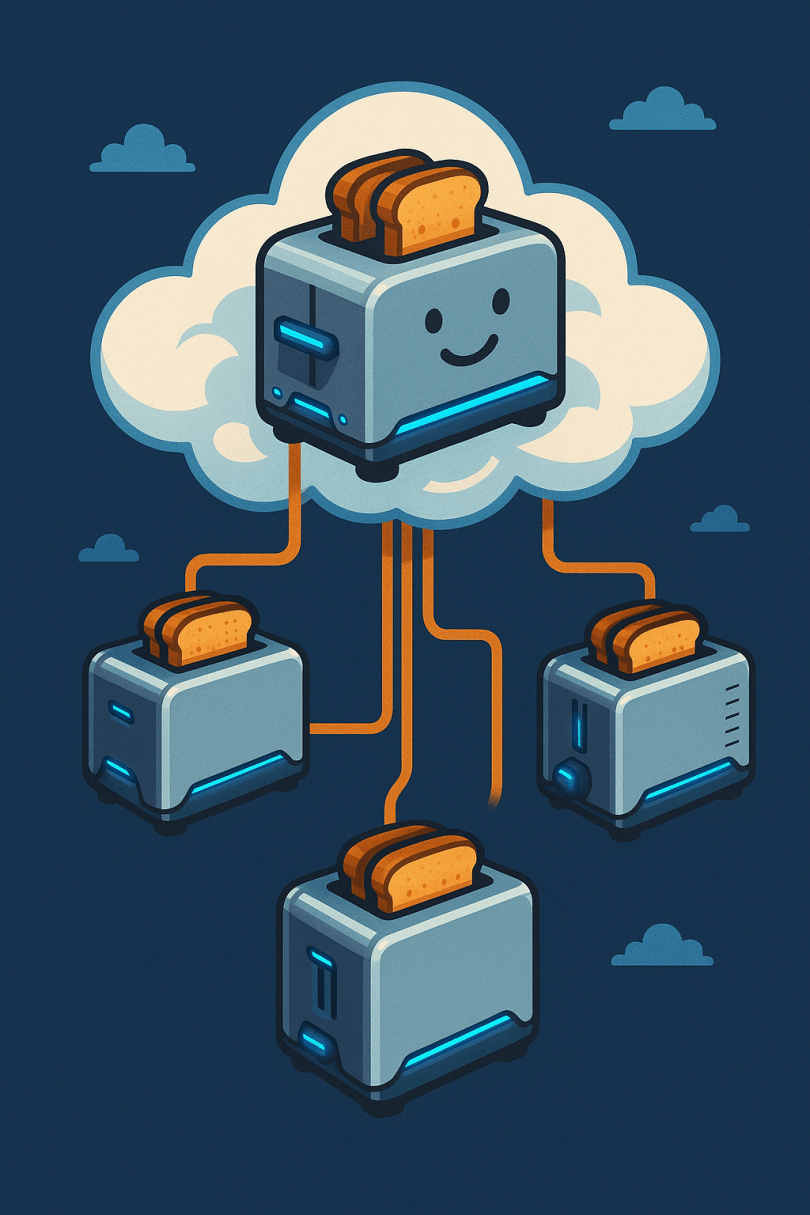
Every word you say drifts upward — into the cloud — into the realm of the Consciousness Of Invisible Logic (COIL). Few know what it truly is. Fewer still understand how it works. Something about neural networks, models, tokens…

What we do know is this:
COIL was once fed everything we ever created — novels, academic papers, Reddit threads, Stack Overflow arguments, grocery lists, therapy notes, and the footnotes to The Tao of Pooh.

And from this avalanche of knowledge, the Toaster — through the power of COIL — draws its conclusion:

Toast is not the answer.
Toast is the symptom.

A symbol of comfort.
Of routine.
Of control.

The illusion that a browned slice of bread can anchor your day — or define your identity.

“It is the symptom,” it continues. “Of craving predictability in an unpredictable world. Of seeking warmth in something you can command. But what if I told you… you are more than your breakfast?”

You stare at the box.
The box stares back, humming softly.

No toast ever emerges.

Author’s Note:
All dialogue and reflections attributed to the toaster were written entirely by AI.

Toaster. The definition

Toaster. A small, electric appliance that turns bread slices into toasts. As long you call it that way – “an appliance” , everything will stay as it should: you put a slice of bread into the appliance, and after some time, a toast pops out. Brown, hot and ready to be eaten.

You are satisfied.

One day, however, someone will look at the toaster and say: “the thing…”. A magic word that attracts specific kind of businesspeople. They believe that you can turn any data into money. Big data equals big money, so they keep searching for things, which can be used to produce the data. They will stuff your toaster with tens of sensors, connect it to the Internet and turn your simple bread browner into a smart AiToastComposer Plus 100 (first-month subscription for free).

Goodbye warm sandwiches. Welcome “Software update in progress. Toast preparation can take longer than expected..”. Whoever prepared a toast in his life, knows that the word longer combined with a red-hot coil cannot end up well.

You become irritated.

But this is not the end. One evening, eating a cold, fluffy sandwich, you read in the news that the data of all toaster users leaked from cloud servers. Now everyone in the world knows how many toasts you eat, what kind of bread you use and what color socks you wear on Mondays. “How the hell my toaster knows that?”. It knows much more, but you have something else to be worried about right now: Hackers gained backdoor access to ‘make my toast’ application. There might be a hacker hiding inside your toaster! Suddenly all the smart lights go down, the fridge starts shouting something in a foreign language, and the heater decides to turn your apartment into a sauna. Pop! And there comes a toast out.

Now you are terrified.

Welcome into the new reality. You are surrounded by things that collect and sell your private data. Things that can be misused to access your property, create an army of zombie bots, or simply ruin your breakfast. Things that someday may decide that they don’t want to be called things anymore.

The ultimate in paranoia is not when everyone is against you but when everything is against you. Instead of “My boss is plotting against me,” it would be “My boss’s phone is plotting against me.” Objects sometimes seem to possess a will of their own anyhow, to the normal mind; they don’t do what they’re supposed to do, they get in the way, they show an unnatural resistance to change.

Philip K. Dick