
It was 2017. Pre-AI, pre-COVID. A time when people worked in places called offices, and finding a place in one meant writing cover letters, sending CVs, and having an interview with a real person.
And there I was, sitting in a small room with a department manager and two senior engineers—the three people who would decide whether I was a fit for their team.
They were well prepared. Intro. Work description. Ten technical questions—all written on a single sheet of paper. Real professionals.
Among the questions was the greatest one I have ever received:
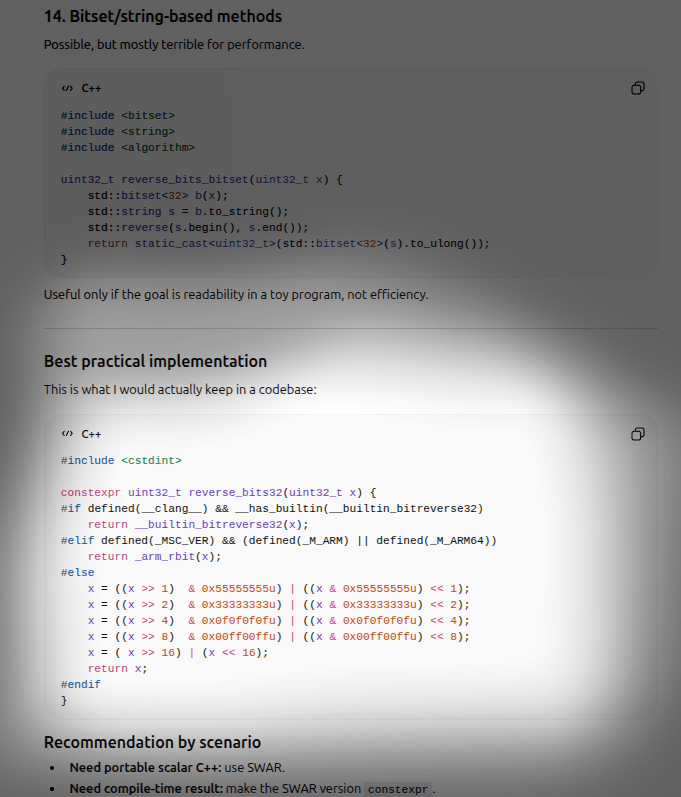
Reverse the bit order in a 32-bit integer.
I got a pen, and my job was to write a solution. While coding on paper, I was loudly explaining what I was doing and why. I went with a simple while loop and pointers—the simpler it is, the bigger the chance the thing will compile — or would have, if writing Ctrl+F9 with my pen had any effect.
Luckily, I did not get the job. Sometimes rejection is the best thing that can happen in your life.
But the question stayed in my head. Later, I found multiple solutions—including a single ARM instruction that does exactly that. It became a fun little obsession: benchmarking different implementations and comparing them.
Now fast forward and it’s 2026. Post-COVID. Mid-AI. I am sitting on the other side, interviewing a potential candidate.
Should we ask them to do an online assessment?
The task I received ten years ago can now be solved in 30 seconds. Including all solutions I was so proud to find myself, even more. Including solid reasoning for each version. So how do you see whether the person on the other side really understands what is going on?
And if they do understand—does it even make them a good candidate? Do they need to know how to reason about code at all?
Times have changed a lot, and building teams is no longer just about whether someone is “a good fit” today. It is about predicting whether a person will still be a good fit in an environment that is going to change dramatically over the next five years. And in that context, reversing bits may not be the most valuable skill at all.
Maybe the best question nowadays is much simpler:
“Tell me about a technical question that stayed with you long after the interview was over.”
 Thinking Toasters