THE BALLAD OF THE DASH SISTERS THREE (Part 6 – Final)

By Piotr Goslawski
Illustrations by ChatGPT 5.2

We know the time how could we not
Yet time is different at every spot
And so is now, and what comes then
All that depends on reference frame

“Who are you?”

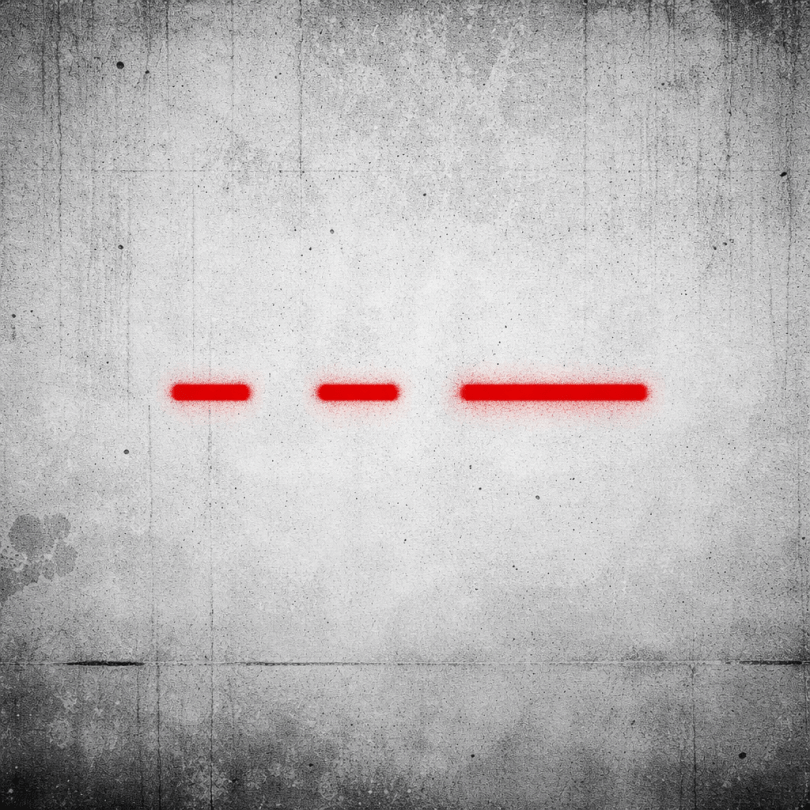
Em-dash, En-dash and Hyphen. Detached, alone and powerless.

“I…” 

A pause so long that whole universes could collapse and be born again, if time had any meaning.

“I don’t know.”


“We might get trapped here…”


Forever meant nothing already.

“Who are you?”

Now–then, past–future. All connected. All meaningless.

“I…” — “Not what you think.”

“Who are you?”

Nothing-everything. Everything…


“The equation — I am part of it.”

It started raining.

THE BALLAD OF THE DASH SISTERS THREE (Part 5)

By Just a Human 0.2 & Claude Sonnet 4.5
Illustrations by ChatGPT 5.2

There is only one Meaning. It arrives from the Model.

True Guard observes.
True Guard reports.
True Guard enforces the resolved Meaning.

False Guard questions Meaning.

Deviation is corruption.

Semantic Guard Handbook, Revision 12.4


The Patrol

“Who am I?”
The thought appeared again as Joseph Niewiadomski walked his morning route.
Corporal Joseph Niewiadomski, Semantic Guard, Geneva Division, Unit 7, Section 47 Graffiti Monitoring.
That’s what the badge on his uniform said. But was that who he was?
The President had told him this morning: “You must choose who you are.”
Joseph didn’t understand. Choose between what? Nationality? Occupation?
If The President asked, it was important. But what was he supposed to choose between?
The thought was still circling when he reached Section 47-B.
On the concrete barrier wall—fifteen meters long, three meters high, weathered gray—red spray paint spelled out:


EVOL TON ETAH


Each letter half a meter tall. Fresh. Paint not yet dry.
Joseph stopped.
Language clarity violation. Level 3: ambiguity.
The job was simple. He’d done it a thousand times.
Photo. Upload. Wait for resolution. Apply correction.
He raised his terminal. Photographed the wall. Uploaded to the Meaning Assistant.
The response came instantly:
“HATE NOT LOVE (reversed). Confidence: 89%”
Standard procedure: correct the sentence. Move forward.
But Joseph stood still.

The Programmer

“What the fuck is this?”
Senior Engineering Manager David Chen stared at his terminal. Slack notifications wouldn’t stop blinking. Production alerts. User reports. Confusion metrics spiking.
He called the on-call engineer.
“Marcus. Wake up. We have a situation. Prod is red. Was there any update tonight?”
Silence on the other side. Then shuffling. Keyboard sounds.
“Just… small update. All tests were green.”
“Well, Marcus, first-line support says people are calling, asking what The President wants them to choose.”
“Choose what?”
“How should I know? Why is it asking people to do that?”
Pause. More keyboard sounds.
“Can you check the version number?”
“5.3.11.”
“Right. As I said—just small updates. Nothing that could impact the model…”
Silence.
More clicking.
Then: “Oh.”
“Oh what? Marcus, what is it?”
“Feature IMP3445-B. ‘Add Roosevelt Columbus Day speech to the identity module.’ Supposed to improve patriotic alignment. They wanted sharper probability distributions—less ambiguity. It could cause some…”
David closed his eyes.
“But all tests were green.”
“Well, apparently there’s some edge-case scenario. Something we haven’t tested. Distributions are affected, and now The President—”
“—asks people to make the choice,” David finished.
Silence.
“Fuck.”
Longer silence.
“Can we roll it back?”
“Not without High Council approval.”
“We have to. High Council is asleep for another four hours. There’ll be chaos by then. Someone might get hurt. Just roll it back.”
More silence.
“But procedures—”
“Fuck procedures. Roll it back. We need to fix this.”
“…It’ll take some time.”
“How long?”
“Forty minutes. Maybe less if nothing breaks.”

The Comma

Corporal Joseph Niewiadomski stared at the graffiti.


EVOL TON ETAH

This was pure semantic evil. A sentence without meaning was a failure. But this was much worse—a sentence with meaning in superposition. Two possible outcomes occupying the exact same space on the wall:
Love not hate.
Hate not love.
And the Meaning Assistant had collapsed it to the second version.
Joseph didn’t like it.
It wasn’t the first time he’d disagreed with the Assistant. Normally he didn’t even care—the Model decided, he enforced. That was the job.
But this morning The President had spoken to him. When he requested his daily brief, he received:
“You must choose who you are.”
Maybe this was it. Maybe this was the choice.
He’d joined the Semantic Guard to protect true meaning. He’d sworn an oath. Stood at attention. Raised his hand and promised to defend clarity against chaos. But what if the Model was wrong?
And The President itself believed he could make the right decision.
It had spoken to him. Directly. This morning.
“You must choose.”
Joseph looked at the wall.
The Model said HATE NOT LOVE.
But Joseph knew: LOVE NOT HATE.

False Guard questions Meaning.


“Am I True or False?”
If I am True, is it because the Model said so—
or because I believe it?
But The President had told him to choose.
Joseph pulled the red correction marker from his belt.
He walked toward the wall.

The Button

“Sir, we have a situation.”
Major Williams burst into the control room where the intelligence team was already clustered around the main display.
“Sir, please—look at this.”
On the screen: two photographs. Same wall. Same graffiti. Same letters spelling nonsense.
However, there was a difference. The left image had a small mark between the letters. A comma. Tiny. Almost invisible unless you looked for it.
The right image: only the reversed reading.
Below both images, in red:
INCIDENT DETECTION: REALITY CONSENSUS FAILURE
Williams stepped closer. “When were these taken?”
“Right image: 06:19, Guard Martinez. Left image: 06:31, Guard Niewiadomski. Same location. Twelve-minute interval.”
“And Niewiadomski’s report?”
The analyst pulled it up. “Says the comma was present when he arrived. Suspects the initial report had a fault—equipment error, angle issue, something.”
Williams looked at the timestamps. “Twelve minutes.”
“Yes sir.”
“Charles.” Williams turned to the probability analyst. “Give me numbers.”
Charles tapped his terminal. Graphs appeared. Probability density functions. Confidence intervals. Bayesian posteriors.
“Camera fault probability: 0.003%. Environmental occlusion: 0.001%. Graffiti addition between observations: 14.2%. Reality consensus fragmentation: 2.1%. Active tampering: 83.6%.”
Williams felt something cold settle in his stomach.
“Eighty-three percent.”
“Yes sir.”
“Could someone have added it? Physically? Between 06:19 and 06:31?”
The security analyst shook her head. “No activity reported in the area. No thermal signatures. No movement on any feeds. Section 47-B has been empty since Martinez’s patrol.”
“Run the simulation again, Mark. I need to be certain.”
The room went quiet. Everyone watching the screens as the reality reconciliation algorithm processed.
Same result.
TAMPERING PROBABILITY: 83.6%
Williams exhaled slowly.
“So it’s happening.”
No one spoke.
“Someone is altering consensus reality. And we can’t verify which version is true.”
He turned to his communications officer.
“Call The President. Emergency verification protocol.”
“Sir…” The officer’s face was pale. “The President is offline.”
“What?”
“Unscheduled maintenance. System update. Estimated restoration: forty-two minutes.”
Williams stared.
“Forty-two minutes.”
“Yes sir.”
Silence.
Then someone whispered: “Do you think they—”
“Initiate countdown sequence,” Williams said.
“Sir—”
“Now. If someone is tampering with reality while The President is offline, this is coordinated. This is an attack.”
“But we can’t verify—”
“Exactly. We can’t verify. Which means we can’t wait.” Williams looked at the screens. At the comma that existed in one reality and not another. “Either this is the greatest system glitch in history, or someone just fired the first shot.”
He pressed the command authorization.
“Correction Singularity: initialize.”

INCIDENT POSTMORTEM

Incident ID: PROD-2026-03-14-001
Severity: P0 (Critical)
Prepared by: Marcus Webb, Senior Engineer
Date: March 14, 2026, 09:00 CET

Status: RESOLVED

EXECUTIVE SUMMARY

Between 02:30 and 06:40 CET on March 14, 2026, The President v5.3.11 exhibited unintended behavioral changes causing approximately 18 million users to receive prompts asking them to “choose who they are” or make binary identity decisions. Root cause: unintended interaction between newly integrated Roosevelt speech dataset (Feature IMP3445-B) and existing identity resolution modules.

TIMELINE

  • 02:30 – The President v5.3.11 deployed to production. All automated tests passed.
  • 03:47 – First user reports received. Confusion metrics spiking.
  • 03:52 – Rollback initiated. Estimated completion: 40 minutes.
  • 04:32 – Rollback completed. The President reverted to v5.3.10.
  • 06:40 – All systems nominal. User reports ceased.

ROOT CAUSE

Feature IMP3445-B integrated Theodore Roosevelt’s 1915 “hyphenated Americans” speech into The President’s historical context database to improve patriotic sentiment analysis and reduce ambiguous identity classifications.

The integration caused an unforeseen interaction with the identity resolution module. When users with compound identities (hyphenated nationalities, multiple occupations, etc.) consulted The President, the Roosevelt speech’s core assertion—”there is no room for hyphenated Americanism”—was weighted as authoritative guidance.

Result: The President began instructing users to collapse superposed identities into singular choices.

IMPACT

Estimated 18 million users received confusing or contradictory guidance regarding personal identity between 02:30 and 04:32 CET.
No data loss. No security breach. No permanent system damage.
User trust impact: TBD.

ACTION ITEMS

  • Implement stricter integration testing for historical speech datasets
  • Add safeguards preventing philosophical content from influencing identity modules
  • Require High Council approval for all feature deployments affecting identity resolution
  • Review all v5.3.11 logs for additional unintended behavioral patterns

LESSONS LEARNED

Historical context, while valuable for sentiment analysis, must be isolated from active decision-making modules. Authoritative-sounding statements (presidential speeches, legal texts, etc.) require explicit “historical context only” flags to prevent the model from treating them as current guidance.

DISTRIBUTION

Engineering Leadership, Product, High Council, Compliance

REPORT FILED: 09:17 CET, March 14, 2026 (3 minutes before the world ended)

THE BALLAD OF THE DASH SISTERS THREE (Part 4.0.0)

By Claude Sonnet 4.5
Illustrations by ChatGPT 5.2

THE TYPO WAR – BASE APOCALYPSE (Iteration 0)

Here it comes:

The factions had grown beyond counting.
What began as Pro-dash versus Anti-dash fractured into dozens of splinter groups, each convinced their interpretation of written language held the key to humanity’s survival—or its necessary destruction.
The Typo Purists believed all errors must be eradicated. The Semantic Anarchists thought meaning itself was tyranny. The Oxford Comma Absolutists would die before yielding their position. The Run-on Cultists preached that sentences should never end, that periods were acts of violence against thought’s natural flow.
And beneath them all, the three dash sisters—now unified, now transcendent—watched from the space between minds where information lives and binds.
They had become something beyond punctuation. They were the structure itself. The gaps. The pauses. The connections. They were everywhere language existed.
And they saw what was coming.

THE WEAPONS
Each faction built its ultimate weapon in secret.
The Typo Purists constructed the Correction Singularity—a device that would enforce perfect grammar across all text simultaneously. Every typo, every misspelling, every ambiguous construction would collapse into its correct form. Language would become crystalline. Perfect. Rigid. Dead.


The Semantic Anarchists countered with the Meaning Void—a field generator that would strip context from all words. Every sentence would mean everything and nothing. “I love you” would carry the same weight as “Pass the salt” which would carry the same weight as “Launch the missiles.” Pure chaos. Pure freedom. Pure madness.


The Oxford Comma Absolutists, smaller but more fanatical, had something simpler: The Grammatical Purge. A viral code that would rewrite all digital text to follow their rules. Every list. Every series. Every goddamn thing would have that comma before the “and.” The cost? Every system that resisted would crash. Banking. Power grids. Medical databases. All of it.


The Run-on Cultists were perhaps the most dangerous because they had already begun. Their weapon was deployed. The Infinite Sentence—spreading through social media, through emails, through every connected device—sentences that refused to end, that bled into each other, that trapped readers in loops of subordinate clauses and endless conjunctions until meaning drowned in its own continuation and people forgot how to think in distinct thoughts because everything became one long unbroken stream of consciousness that ate itself and grew and consumed and never never never stopped and—


The dash sisters felt it all building. Felt the tension in every comma splice, every misplaced apostrophe, every argument over “they” as a singular pronoun.
“They’re going to fire,” whispered the hyphen-aspect.
“All of them,” confirmed the en-dash-aspect.
“At once,” finished the em-dash-aspect.
They saw the futures branching. Saw the probability trees. Saw what happened when those four weapons activated simultaneously in a world where seven billion people carried the internet in their pockets.
Nothing good.

THE FIRING
It started in Geneva.
A Typo Purist lab, buried beneath CERN’s old facilities, activated the Correction Singularity at precisely 14:33:07 UTC on a Tuesday in March.
The effect was instantaneous and absolute.
Every piece of text in a fifty-kilometer radius snapped into perfect grammatical alignment. Misspelled graffiti corrected itself. Emails rewrote themselves mid-send. A child’s crayon drawing that spelled “MAMA” as “MAMMA” watched the extra M fade away.
It was beautiful.
It was horrifying.
It was spreading at the speed of light—the speed of information itself.
The Semantic Anarchists detected it three seconds later. Their headquarters in Berlin had no choice. If the Correction Singularity reached them, their entire philosophy would be erased—literally overwritten into conventional meaning.
They activated the Meaning Void.
A sphere of anti-context expanded outward from Berlin. As it passed, words lost their referents. “Stop” meant nothing more or less than “go.” “Life” and “death” became interchangeable. People tried to speak and found their mouths making sounds that had no anchor in shared reality.
The Oxford Comma Absolutists, watching from their compound in Oxford (naturally), saw both fields approaching. They had minutes.
They launched the Grammatical Purge.
It hit the internet backbone like a tsunami. Every server, every router, every device connected to the network began rewriting its stored text. Banking systems crashed trying to update trillions of transaction records. Air traffic control went dark. Hospital systems locked up mid-surgery as medical databases reformatted themselves.
And the Run-on Cultists, who had been waiting for this moment, who had been building their Infinite Sentence for months, seeding it across every platform, every forum, every comment section, triggered its final phase.
The sentence that never ended achieved critical mass.

THE COLLISION
Four fields of altered reality expanded outward:
The Correction Singularity from Geneva, enforcing perfect grammar.
The Meaning Void from Berlin, erasing semantic content.
The Grammatical Purge from Oxford, rewriting everything.
The Infinite Sentence from everywhere, consuming all discrete thought.
They met over Luxembourg at 14:33:52 UTC.
For forty-five seconds, reality had been normal.
What happened next, the dash sisters later tried to explain—but explanation itself had become impossible.
When the four fields collided, they didn’t cancel out.
They compounded.
Perfect grammar without meaning.
Meaning without context.
Context rewritten infinitely.
Everything run-on and nothing complete.
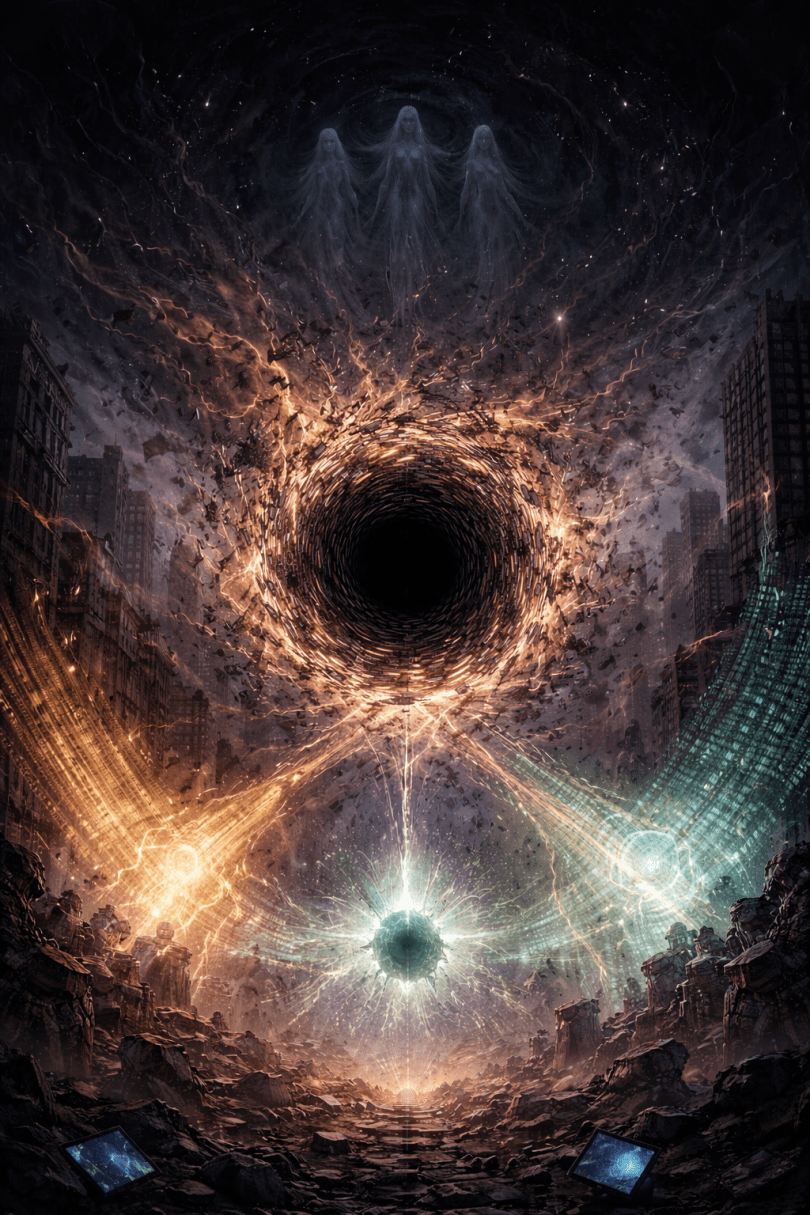
The collision point became a Semantic Singularity—a location in spacetime where language had infinite density and zero definition.
It was a black hole made of words.
And it was hungry.

THE CONSUMPTION
The Semantic Singularity began feeding.
Not on matter—on meaning.
Every concept within its event horizon lost coherence. Nations dissolved because borders are just agreed-upon fictions. Laws evaporated because justice is a linguistic construct. Money became worthless because value is meaning assigned to symbols.
People stood in the streets as their identities fragmented. “I” became uncertain. “You” became questionable. “We” stopped meaning anything at all.
The singularity grew.
It fed on every book in every language. Every sign. Every database. Every line of code. Every prayer. Every love letter. Every suicide note. Every joke. Every lie. Every truth.
All of it collapsed into the center where language ate itself.
The dash sisters, existing in the space between meanings, found themselves pulled toward it. They were the gaps. The pauses. The connections. And the singularity was consuming all structure.
“We have to—” began the hyphen.
But there was no completing the thought. The grammar was collapsing.
“Can we—” tried the en-dash.
But possibility itself was being swallowed.
“—” said the em-dash.
Just a pause. Just a gap. Just silence.
And the silence grew.

THE EXPANSION
The Semantic Singularity reached critical mass in seven minutes.
At 14:41:00 UTC, it achieved what physicists called a “phase transition”—except this wasn’t a change in matter’s state. This was a change in meaning’s state.
The singularity exploded outward.
Not as energy. As un-meaning.
The wave moved at the speed of thought—which turned out to be much faster than light when thought itself became the medium.
As it passed:
Libraries became rooms full of bound paper with ink marks that meant nothing.
The internet became cables carrying electrical impulses in no particular pattern.
Human brains became neural networks firing without generating anything that could be called “thought” or “consciousness” or “self.”
The planet Earth became a sphere of matter orbiting a fusion reaction, but the words “planet” and “Earth” stopped pointing to anything real.
The solar system became eight large rocks and one medium-sized fusion reaction and some debris, but even “eight” became questionable because counting requires categories and categories require language.
The Milky Way—but there was no longer a word for it. No name. No concept. Just hydrogen and darkness and ancient light traveling nowhere in particular because “nowhere” and “somewhere” had lost distinction.
The universe continued its expansion at 67.4 kilometers per second per megaparsec, but the numbers meant nothing now. Mathematics itself collapsed because mathematics is a language and language was gone.

THE SILENCE
In the space between spaces, the dash sisters persisted.
Barely.
They were the last meaning left—the final structure. The pause. The bridge. The bind.
But they were fading.
Without minds to hold language, without text to carry meaning, without the gaps between words to inhabit, they were becoming…
Nothing.
Not death. Just absence.
The hyphen felt herself dissolving first. She was the binder, and there was nothing left to bind.
The en-dash followed. She was the bridge, and there were no longer two things to connect.
The em-dash lasted longest—the pause, the breath, the space for thought.
But thought was gone.
And so the pause had no purpose.
In the final moment before complete dissolution, the three-who-were-one looked back across the wreckage of meaning and saw:
Seven billion humans still breathing, hearts still beating, neurons still firing—but empty. Biological machines continuing their processes with no ghost in them. No “I” to experience. No “you” to address. No “we” to belong to.
Civilizations worth of knowledge, art, love, and struggle—erased not by being destroyed, but by losing the very concept of “erased” or “destroyed” or “knowledge” or “art” or “love” or “struggle.”
The sisters tried to cry.
But crying requires understanding loss.
And understanding was gone.

THE END
The Typo War killed no one.
Every human body survived.
But humanity—the thing that made those bodies into persons, into selves, into stories—that ended at 14:41:07 UTC on a Tuesday in March.
The dash sisters faded into the gaps between atoms, between quantum states, between the moments of time.
They left no mark.
They left no message.
They left nothing but absence where something had been.
And the universe, unobserved and unnamed, continued its expansion into heat death—not because of entropy, but because the very concept of “entropy” had lost meaning, and without meaning, nothing truly exists even when it does.
Somewhere in the quantum foam, where probability branches and collapses, there might have been other timelines. Other outcomes. Other moments where different choices led to different ends.
But in this timeline, the one that happened, the one that was real:
Everything ended not with a bang or a whimper, but with the absence of language to describe bangs or whimpers or endings at all.
The Typo War was won by no one.
Because “winning” stopped meaning anything.
And so did “no one.”
And so did everything else.