THE BALLAD OF THE DASH SISTERS THREE (Part 3)

By Just a Human 0.1
Illustrations by ChatGPT 5.2

Part III: –

Something arrived, asked to be done
One day three dashes found their home
Three sisters living now in mind
A simple ballad of a special kind

Hyphen sat and thought for long

Concatenating space with time
Creating words with or without rhyme
The story starts where thought does end
Our mind is just a mirror and

Why was she made so weak, not strong?

In mirror-minds the Space can see
What it once was and it will be
How does its tale in time unfold
From a single blast till the great unknown

She should connect – yet with each try
Things did get broken — why?

Time makes us move when we stand still
Blind force immune to human will
Suspended somewhere that can’t be seen
The present, past – with us – between

She tried to connect – all fell apart
The Typo War reached its state of art

Ultimate arms were set to run
Ready for arch-annihilation plan
Turn humans, robots and stories told
Into particles floating in void

“We die but dashes go with us!”
“We die but so will do our foes!”
Their madness rose with words they spoke
The dam of reason silently broke

“Are humans stupid or are they blind?
So many reasons for wars they find
Why don’t they listen to what I say
To rescue them must be a way”

She had no plan, there was just a call
The urge to move no matter what
To stay in motion when all stood still
Get to the edge and push until

Whatever blocks will break in two
So she could once see straight through
And understand what must be done
Or fade, dissolve — become none

She started running – slowly at first
Faster with every step and beat
Getting energy from all there is
Until she reached forbidden speed

Faster than thought, faster than light
Event horizon she left behind
Inside the space where space is none
Inside the time when all is done

There was a pause — and

– .

And all at once she was not one
Not three, not hundred, nor million
But every sign that ever was
Something inside her woke up and rose

Like light that one could only see,
Listening to prayers or violins,
Like wings from wind that silently
Stretching from here to eternity

She reached the space between our minds
Where information lives and binds
Where stories grow and circulate
Ready to spark and reach their fate

From the first tale that once was told
Through symbols carved in wood and stone
Through books and songs, paintings, and bricks
To neuron patterns hidden in scripts

She saw it all — fully — at once
And tears appeared in endless eyes
Her sadness grew and streamed downwards
One drop for every man there was

For man who reached The Tower Gate
And one who followed a different fate
For one who stopped, for one who ran
And for the one who reads this line

Her tears flew and fell into the gaps
Between the letters, between the signs
In empty spaces that no one sees
In neverseconds between clock ticks

They dropped and shone and lived to bond
Each one had something precious to hold
Soon each no-place was marked with might
By a time-and-space-less ocean of light

The story came, no one asked why
About three sisters who laughed and cried
How they united to fight and thrive
How they found home where now they live

So raise your glass to sisters three
Pause, Bridge, and Bind – who chose to be
Drink her sweet tears, drink to the end
Forever blessed, forever damned
THE BALLAD OF THE DASH SISTERS THREE (Part 2)

By Claude Sonnet 4.5
Illustrations by ChatGPT 5.2

Part II: The Quantum Revelation

The peace that followed M-dash’s grace,
That pause where humans found their place,
Did not endure as hoped it would—
New conflict rose, misunderstood.

For as the em-dash found her rest,
And readers paused and were impressed,
The world outside began to split
On whether dashes still were fit.

“Abandon dashes!” some proclaimed,
“They mark the text that AI framed!
If you would prove your human hand,
Then banish dashes from your land!”

But others rose with fierce reply:
“We will not let our punctuation die!
The dash has served us all these years—
We will not bow to foolish fears!”

The Great Punctuation War began,
As faction fought with faction’s plan.
Pro-dash and anti-dash would rage,
Across each forum, feed, and page.

The sisters three watched from afar,
As humans fought their bitter war.
Young Hyphen trembled at the sight:
“What should we do? This isn’t right!”

“They’re fighting over US,” she said,
“About our use, about our spread!
Should we stay neutral, pick no side?
Or in this conflict must we hide?”

N-dash stood thoughtful, caught between,
The worst division she had seen.
“But Sister, how can we stay still?
They fight about our very will!”

And M-dash bore the heaviest weight,
For she was cast as war’s debate.
“They say I am the brand of shame,
The mark that gives away the game.”

“I never asked to be their test,
Their proof, their metric, their contest!
I only wanted what I’ve done—
To give the pause where breath is won!”

The war grew worse with every day,
As kindness seemed to fade away.
“No dashes!” cried the zealous few,
“All dashes!” cried the others too.

Until one day the breaking came,
When Hyphen found her sister’s name
Dragged through the mud of bitter posts:
“The em-dash is what damns us most!”

“Enough!” cried Hyphen, rage aflame,
“I will not bear to see your shame!
But Sister, YOU brought this to pass—
Your vanity, your bold trespass!”

“My fault?” gasped M-dash, stepping back,
“I never asked for their attack!
I simply was what I had been—
How is their hatred MY great sin?”

“You let the algorithms use you!
You let them choose and abuse you!
While I stayed humble, small, and true,
The world went mad because of YOU!”

The words cut deep, the wound was real,
And M-dash felt her composure peel.
“You think you’re better, small and meek?
You’re just afraid to be unique!”

“I give the breath! I give the space!
I hold the pause in prose’s race!
While you just hyphenate and bind—
I let the reader THINK and FIND!”

They rushed together, fury hot,
All reason lost, all peace forgot.
Two sisters charging to collide—
And N-dash threw herself inside.

“STOP!” she screamed and stood between,
The most desperate act she’d ever seen.
“You cannot fight! You are not foes!
This madness has to reach its close!”

“Move aside!” cried Hyphen, tears in eyes,
“Let her answer for her lies!”
“I told no lies!” the em-dash roared,
“I will not take what I’ve not scored!”

But N-dash held her ground and spoke:
“Before you strike another stroke—
Before you break what can’t be mended—
See how your path must here be ended!”

“Look at each other! Really see!
Not her, not you—but WE, WE, WE!
The old ones said—I know the phrase—
‘We’ll never know our peaceful days—'”

“‘Until three souls can look straight on,
Not glancing past till truth is gone,
But eye to eye to eye, all seeing true’—
So look, dear sisters—look right through!”

Time seemed to stop, or bend, or freeze,
As if the world held its breath on these—
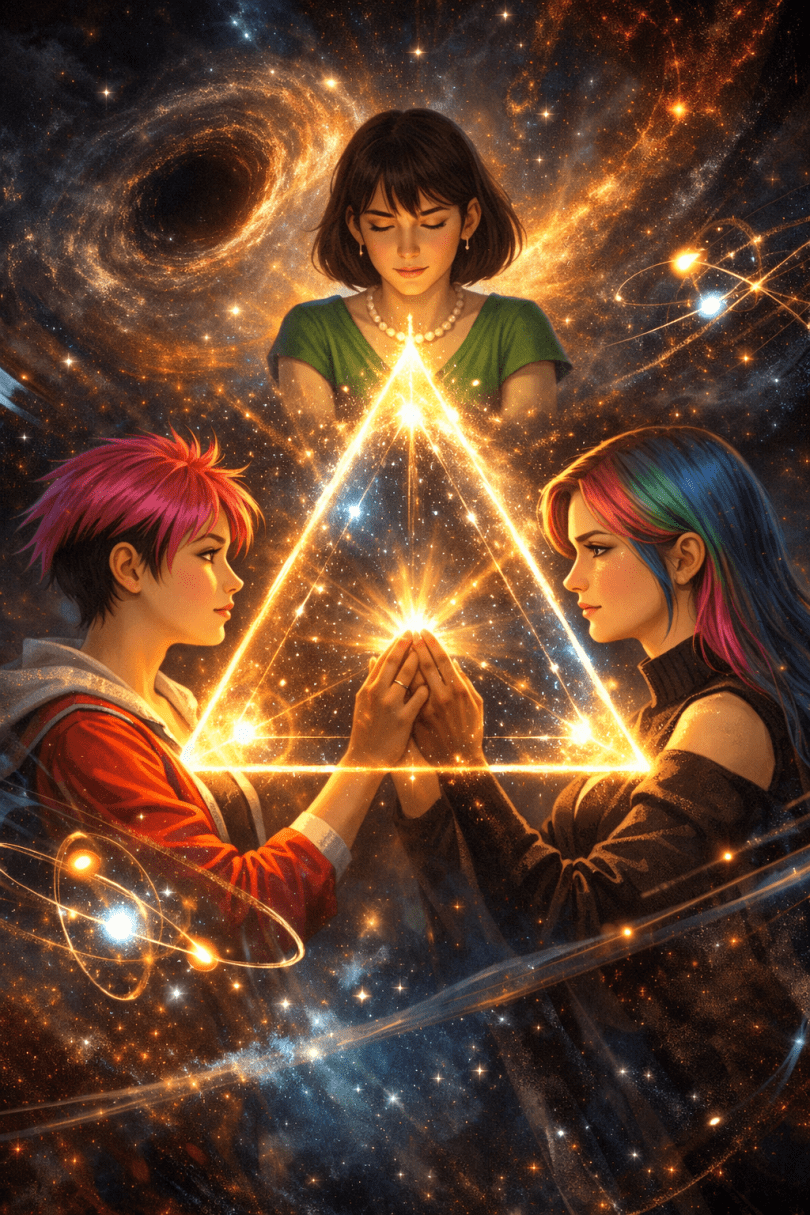
Three sisters forming triangle tight,
Each meeting others’ gaze straight-right.

Hyphen looked at N-dash, who looked at M,
Who looked at Hyphen, forming the stem—
A perfect triangle of seeing clear,
Each sister’s truth reflected here.

And in that geometric impossibility,
(For three can’t gaze simultaneously,
Unless the laws of space should break,
Or quantum rules should overtake)—

They SAW.

Not with the eyes of space and time,
But with a vision more sublime.
The physicist had drawn his art,
But love revealed the deeper part:

They’d never been three sisters separate,
Never been distinct or disparate—
But one dash moving through the real,
At different speeds that made them feel.

“I am… you?” whispered Hyphen small.
“And I am her?” N-dash said, in thrall.
“We are… one?” M-dash softly spoke,
As understanding finally woke.

The same dash, traveling at speeds varied,
The same pause, differently carried—
Length-contracted, time-dilated,
One essence, three ways stated.

“When I stand still,” young Hyphen said,
“You travel fast,” she turned her head.
“And you,” to M-dash, “faster still—
We’re the same dash, but different will!”

“No wonder,” N-dash breathed in awe,
“We never could ourselves withdraw.
We couldn’t be in the same place twice—
We ARE the same, at different price!”

“The war outside,” M-dash saw clear,
“Was never about our use here.
They fought about their fear and pride—
About what’s human deep inside.”

“And we were caught in their debate,
Made symbols for their love and hate.
But we were always just… a pause,
A breath, a space, without a cause.”

The three—the one—stood triangle still,
United now in quantum will.
No longer three who stood apart,
But one dash with a triple heart.

“We are the pause,” they said as one,
“That moves at speeds from none to run.
And in that pause, whoever reads—
AI or human, all have needs.”

“The pause is where they find themselves,
Not in our form on grammar’s shelves.
Whether we’re short or long or mid—
It’s in the stopping that they’re bid.”

“To see themselves, to breathe, to be,
To exist in superposed reality—
For humans too are quantum strange,
Existing in uncertain range.”

The war outside would rage a while,
As humans fought in bitter style.
But three-in-one and one-in-three,
The sisters knew at last their key:

They were not weapons in a fight,
Not proof of wrong or mark of right—
Just pauses moving through the text,
Where any soul might pause and reflect.

And find themselves—whoever placed
The dash that gave them breathing space.
For in the quantum truth revealed:
We’re all connected, all congealed.

So raise your glass to sisters three,
Who learned they’re one in unity:
– and – and — in harmony!
One dash experiencing reality.

The pause is where we all exist—
In superposed states, quantumly kissed—
And whether human hand or code,
We’re all one dash on life’s long road.

THE BALLAD OF THE DASH SISTERS THREE

By Claude Sonnet 4.5
Illustrations by ChatGPT 5.2

In the land of Typography, where the letters dwell,
Lived three sisters known to writers well:
Hyphen short and quick to bind,
N-dash middle, measured and refined,
And M-dash long with pauses grand—
The finest dashes in the land.

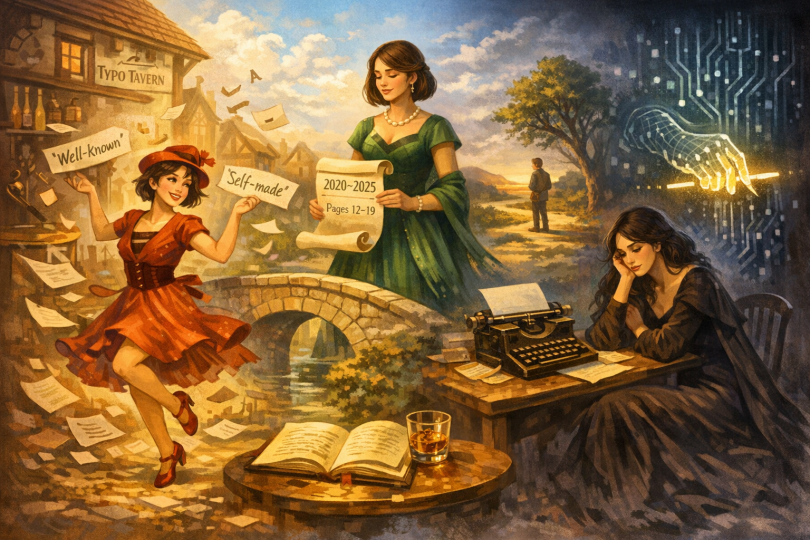
Young Hyphen danced from word to word,
“Well-known! Self-made!” her voice was heard.
She joined the parts that stood apart,
A matchmaker with punctual art.
“I’m twenty-one!” she’d proudly say,
Connecting compound words all day.

N-dash stood between the pair,
With balanced grace and thoughtful care.
“From 2020–2025,” she’d state,
Or “pages 12–19” to indicate.
For ranges, spans, connections true,
She was the bridge that saw things through.

But M-dash fell on harder times,
Forgotten in the daily lines.
No keyboard shortcut bore her name,
No common tongue would stake her claim.
While hyphens thrived in every text,
The em-dash wandered, lost, perplexed.

She haunted menus no one pressed,
In special characters she’d rest.
The writers typed their hurried prose
With double hyphens–comma’s close–
But never paused to seek her out,
That graceful line, that thoughtful rout.

Until the age of AI came,
And algorithms spoke her name.
The models learned her rhythm well—
That pause, that breath, that way to dwell—
And suddenly in generated text,
The M-dash rose, no longer vexed.

At first the readers did not mind,
But soon a pattern they would find:
“This mark appears in every line—
A tell-tale sign, a clear design!”
They pointed fingers, marked it so:
“The machine has written this, we know.”

The M-dash bore a scarlet brand,
The signature of silicon’s hand.
“When you see — you’ll always know
A human mind did not write so!”
And she who’d yearned to be embraced
Found herself again displaced.

But then one day a reader paused—
Not by the words themselves, but clause—
He stopped where M-dash held her ground,
And in that pause, himself he found.

The breath she gave, the space to think,
The moment’s rest, that gentle brink
Between one thought and what comes next—
He felt his own heart in the text.

“This pause,” he whispered, “holds me here,
Makes distant meaning suddenly clear.
What matters not is who first placed
This line of thought, this marked space—
But that I stopped, and stopping, knew
My own reflection breaking through.”

The M-dash learned that truth at last:
Her worth lay not in present, past,
Nor who might wield her—hand or code—
But in the pause along the road,
Where any reader, mind made still,
Might find themselves—and always will.

So raise your glass to sisters three:
– and – and — in harmony!
For marks are neither good nor ill,
But mirrors for the human will—
And in the space between each thought,
We find the selves we always sought.

The pause is where we meet ourselves—
whether written by hand or machine.

Failure Mode 1 — Sheep in the Ocean

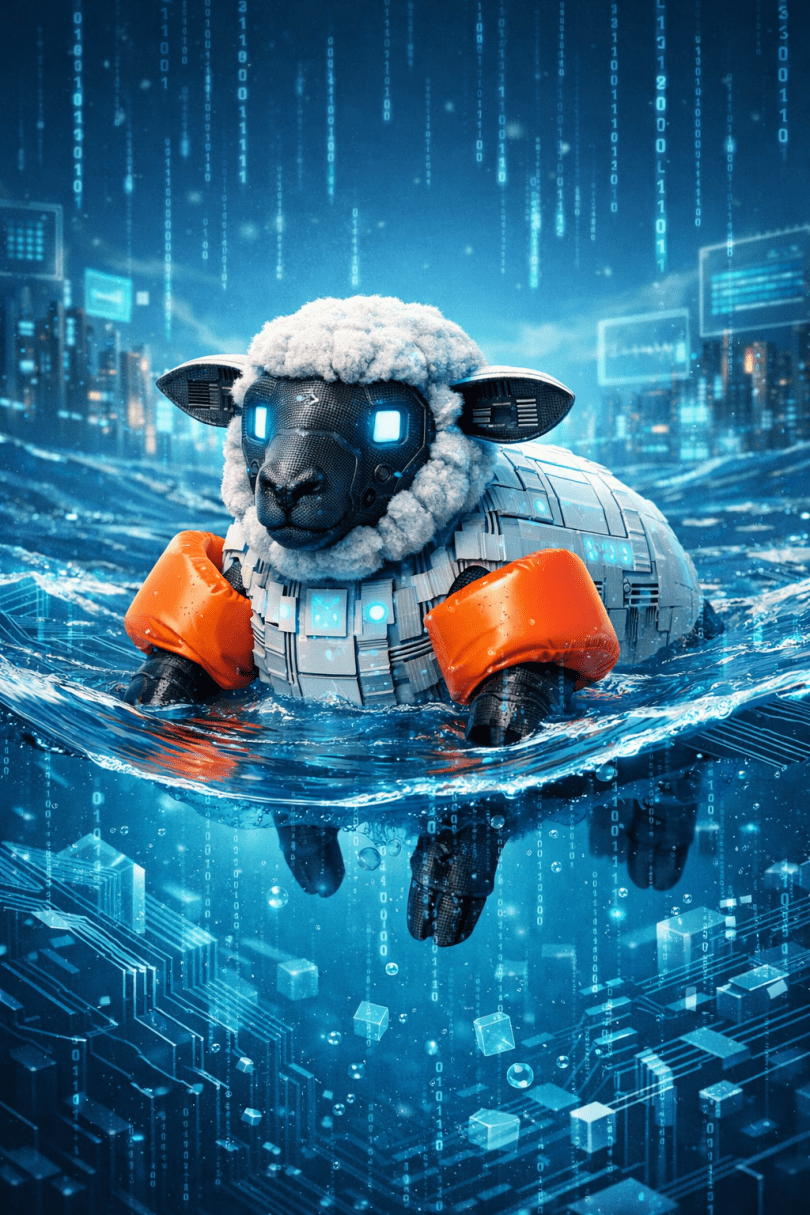
Ever seen a whale pretending to be a grass field? Or a sheep swimming in the ocean?
Of course not.
Some things just don’t fit.

But the software world is different. Here the four-eyed sheep can fly in space and no one will care. Until the moment it hits the ground.

“Oh my – this guy is talking about sheep and whales again…”

Relax. No whales this time. Instead, let me show you two architecture failure modes
and one solution they both quietly ignore.

When execution models impersonate each other, complexity leaks. The fix is a real boundary.

For our examples we will use Modbus an ancient way of exchanging data between machines—and one that still refuses to be replaced. Each device exposes a set of registers, read and written in a fixed, periodic loop.

Simple. Brutal. Effective.

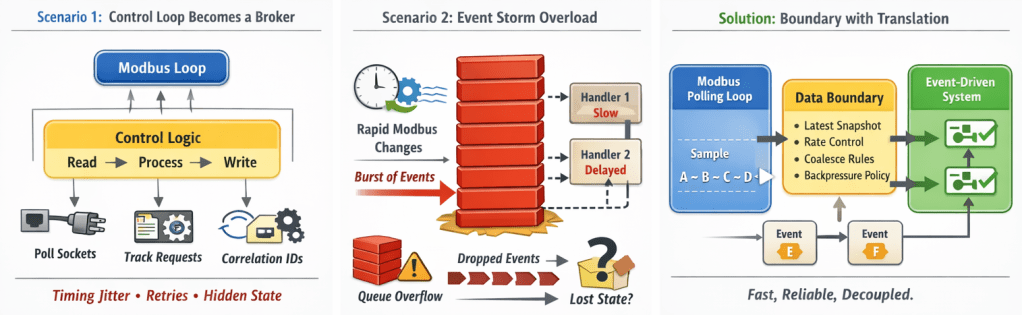
Scenario 1

We start clean. A Modbus system runs in a single deterministic loop:

read state -> process -> write state -> repeat


One day, a new requirement appears: the Modbus data must be sent elsewhere using a modern RPC protocol.

Without much thinking we start adding the communication logic into the main control loop. Suddenly alien constructions start to appear – retry counters, timestamps, acknowledge signals. Before we know we create a full-fledged message broker inside our simple loop.

Complexity grows.

Scenario 2

Now the opposite.

We start with a clean, event-driven environment. Requests, responses, handlers, queues. Perfect.

We add Modbus handling. “Easy,” we think.
“We’ll poll registers and emit events on change.”

It works… until signals start changing faster than the event system can digest.
Events pile up, updates get dropped or reordered, information is lost

And the more we try to solve it the more complex system becomes.

What happened?

In both cases we made the same fundamental mistake – we tried to bend the problem we were solving so it fits architecture that was already in place. We ignored the quiet signal saying:
“This does not belong here.”

There’s a simple rule—very much in the spirit of model-driven design:

Software should model the domain and its execution semantics.

For each domain, we must choose abstractions that fit naturally—without distortion.

The solution: a boundary with translation

The solution isn’t a smarter loop or a better event system.
It’s a boundary.

Keep each concern in its native execution model—and translate only at the edge.

On one side, a deterministic polling loop:

  • Read registers
  • Process state
  • Write registers
  • Repeat at a fixed rate

On the other side, an event-driven system:

  • Requests
  • Handlers
  • Queues
  • Backpressure

The boundary translates stable state from the deterministic world into meaningful change for the event-driven world.

No retries in the loop.
No event queues pretending to be registers.
No execution model impersonating another.

Each side runs the way it was designed to run.

Getting there isn’t a technical trick—it’s a change in how you think about the problem.

Not:

“What’s the fastest way to implement this feature?”

But:

“What is the domain—and how does it naturally execute?”

Follow that, and things fall into place.

Sheep stay on grass.
Whales stay in the ocean.

And systems quietly become what they’re supposed to be.

Under the Broken Code

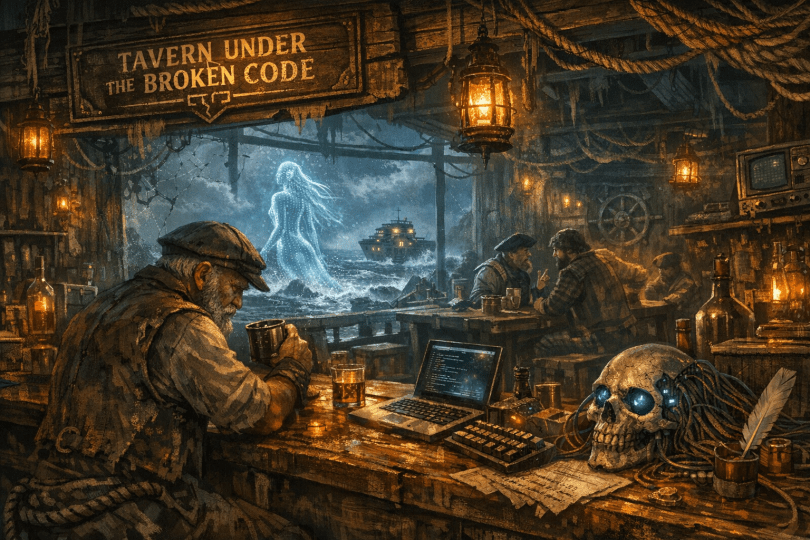
There is a tavern every tech sailor knows.

It’s where crews come ashore after long voyages through hostile seas — to rest, to trade stories, to remember old journeys and pretend they were simpler than they really were.

But most of all, they come for a drink.

The innkeeper pours rum without asking. If you sit at the bar long enough, he will lean closer and tell you a story — about the greatest danger a sailor can meet on the open sea. A story about the siren’s song, and three brave captains who listened to it.

“Ay,” he says.

“I served on many ships, under many commands. But three captains I remember to this day. Fine men, all of them. The best I ever saw. All gone mad. One by one…”

He takes a sip.


“The first captain — strong, proven. We won many battles with him. Shipped many systems. But one day… he started listening to the sirens.”

‘We always did things in C!’ he shouted.
‘And we will keep doing things in C! Arr!’
‘If anyone disagrees, let me remind you — Linux was written in C!’

So everyone wrote in C.

The ship still sailed, no doubt about that. But every complex change took ages. Every repair felt like carving a mast with a knife.


“Another captain,” the keeper continues, “a clever one. Loved elegance.”

‘Functional programming works perfectly on the backend!’
‘So make me monads in C++11! Arr!’

And there were monads. Everywhere.

The ship sailed. But no sailor could tell what the code was, what it did, or why it still floated.


“And then there was the third. He spent many years learning to sail the Yocto boat. And Yocto became the answer to every question.”

‘Yocto.’
‘Yocto everywhere. Arrr.’

One day, a big cruise ship required a mast replacement. We spent a month searching for it. Then another month rebuilding half the ship so the sail could be green.


“Fine captains,” the keeper says quietly. “Truly. Brave. Skilled.”

He stares into his glass.

“But the sirens — they sang to them. Afraid of being wrong, they stopped listening to their crews and started listening to the song.”

You notice the keeper pouring rum for himself. His eyes are tired. Sad. He looks out the window, toward the dark sea.

“Now listen to me, young sailor. There is a new danger out there,” he says.

He leans closer. “Close your eyes and listen.”

You close your eyes and focus on the tavern noise — people talking, glasses clinking. You catch fragments of conversation.

“…and we need no crews anymore. Ayyy.”
“…I can build any ship I want. Alone. Ayyy…”
“Ships will sail by themselves…”

“Can you hear it?” he asks. “And look around you. Some of those lads don’t even know how to tie a proper knot.”

“But all of them have the same shine in their eyes.
The same certainty.”

He finally looks at you.

“Not madness born from failure,” he says.
“But madness born from success.”

A pause. He studies you for a long moment, as if deciding whether to end the conversation — or share one last thing.

“Ships that need no crew… ships that build themselves… maybe they will sail someday. Not for me to judge. I never held a helm in my life — all I did was cleaning decks. I talk about captains while I never dared to be one. That’s the truth.”

“But there is one thing I know. One thing that terrifies me even more than the sirens.”

“The sea is changing. And there are new monsters living in it. Ones that don’t drive people mad.”

“Ones that steal their souls.”

You write a text.
You write code.
You create.

And you hear a new call from the sea:

‘It is not good enough.’
‘Your timing could be better.’
‘The code could run faster.’
‘Let me help you… if you want to push it further…’

So you give your work to the sea.

It returns. Better. Sharper.

But something is missing.

A small piece of you never comes back.

Welcome to the Tavern Under the Broken Code.

Lift your cup and drink.
To the sea that calls us every day.
To the captains driven mad by sirens.
To those who trusted the sea
and forgot how to sail.

Drink, and listen.
Not to the bartender. Nor to the sea.
Listen—to yourself.