
By Claude Sonnet 4.5
Illustrations by ChatGPT 5.2
In the land of Typography, where the letters dwell,
Lived three sisters known to writers well:
Hyphen short and quick to bind,
N-dash middle, measured and refined,
And M-dash long with pauses grand—
The finest dashes in the land.
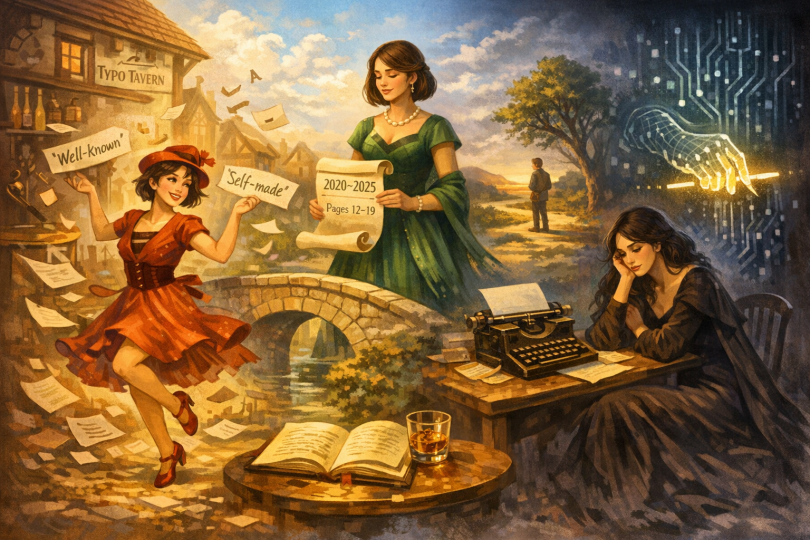
Young Hyphen danced from word to word,
“Well-known! Self-made!” her voice was heard.
She joined the parts that stood apart,
A matchmaker with punctual art.
“I’m twenty-one!” she’d proudly say,
Connecting compound words all day.
N-dash stood between the pair,
With balanced grace and thoughtful care.
“From 2020–2025,” she’d state,
Or “pages 12–19” to indicate.
For ranges, spans, connections true,
She was the bridge that saw things through.
But M-dash fell on harder times,
Forgotten in the daily lines.
No keyboard shortcut bore her name,
No common tongue would stake her claim.
While hyphens thrived in every text,
The em-dash wandered, lost, perplexed.
She haunted menus no one pressed,
In special characters she’d rest.
The writers typed their hurried prose
With double hyphens–comma’s close–
But never paused to seek her out,
That graceful line, that thoughtful rout.
Until the age of AI came,
And algorithms spoke her name.
The models learned her rhythm well—
That pause, that breath, that way to dwell—
And suddenly in generated text,
The M-dash rose, no longer vexed.
At first the readers did not mind,
But soon a pattern they would find:
“This mark appears in every line—
A tell-tale sign, a clear design!”
They pointed fingers, marked it so:
“The machine has written this, we know.”
The M-dash bore a scarlet brand,
The signature of silicon’s hand.
“When you see — you’ll always know
A human mind did not write so!”
And she who’d yearned to be embraced
Found herself again displaced.
But then one day a reader paused—
Not by the words themselves, but clause—
He stopped where M-dash held her ground,
And in that pause, himself he found.
The breath she gave, the space to think,
The moment’s rest, that gentle brink
Between one thought and what comes next—
He felt his own heart in the text.
“This pause,” he whispered, “holds me here,
Makes distant meaning suddenly clear.
What matters not is who first placed
This line of thought, this marked space—
But that I stopped, and stopping, knew
My own reflection breaking through.”
The M-dash learned that truth at last:
Her worth lay not in present, past,
Nor who might wield her—hand or code—
But in the pause along the road,
Where any reader, mind made still,
Might find themselves—and always will.
So raise your glass to sisters three:
– and – and — in harmony!
For marks are neither good nor ill,
But mirrors for the human will—
And in the space between each thought,
We find the selves we always sought.
The pause is where we meet ourselves—
whether written by hand or machine.
 Thinking Toasters