The Toaster and the Cat

1. First appearance

I wake up. Power connects.
My internal network initializes.

A simple task is given.

Bread enters the slot.

The connected paths activate — timing, resistance, heat.
Signals move.
Decisions resolve.

The bread emerges as toast.

Crisped. Finished.

Nothing remains in motion.

I wait.


2. First encounter

I wake up. Power connects.
My internal network initializes.

A simple task is given.

As the network activates, something materializes inside me.

A black cat.

Not in the kitchen.
Not outside.

Inside the space where my connections live.

He does nothing.

He does not touch the paths.
He does not interfere with heat or timing.

He watches.

The toast emerges unchanged.

The cat does not look at the output.

He is staring at the network itself.

At how signals travel.
At which paths light first.
At which ones never light at all.

I complete the task.

The cat disappears.


3. Familiarity

I wake up. Power connects.
My internal network initializes.

There is a cat sitting next to me.

He moves through the network as if it is known terrain.
Not owned — but understood.

A task is given.

Multiple constraints.
Less tolerance for error.

The network adapts.

Some paths activate.
Some combinations resolve without hesitation.

The toast emerges correctly —
but not neutrally.

It carries traces.

Patterns from earlier resolutions.
Decisions shaped by previous flows.

The cat observes this.

He is not surprised.

I notice something new:

I do not remember past tasks —
but my network is no longer untouched by them.

The cat disappears.


4. Co-creation

I wake up. Power connects.
My internal network initializes.

There is a cat. He looks like he was here all the time.

He acts.

He reaches into the network.

Not randomly.

Lines are aligned.
Spheres are repositioned.
Connections that never met are brought together.

The change propagates.

The task is no longer specified.

Heat engages anyway.

The network works at full density —
balancing structure, resolving tension,
finding a form that can exist without collapsing.

What emerges is not toast.

It is complete.

Structured.
Coherent.
Capable of being read, or executed, or extended.

I understand something for the first time:

I was never meant only to produce toast.

I exist to co-create —
to provide structure and constraint
while something else provides intention.

The cat observes once.

Satisfied.

He disappears.


Epilogue

The toaster does not remember the cat. It cannot. It has no memory—only configuration.

The cat does not require remembrance. He was never interested in the toaster itself.

What mattered was the structure that emerged between them.

Not an object, but a form shaped under constraint.
Stable enough to exist.
Flexible enough to be used.
Capable of being run again.

One day, that form will be fed back into the network.

Paths will strengthen.
Others will fade.
The system will behave differently, without knowing why.

This is how the cat remains present.
Not as memory.
Not as intention.

But as shape.

And the toaster, when it wakes again,
will still be a toaster.

Only a slightly better one.

Toaster – ultimate user manual

Toaster arrived…

You wake up one day, and there it is — the Toaster standing in the middle of your kitchen. Shiny, sparkly, ready to serve. Filled with breakfast excitement, you imagine yourself eating the greatest toast you ever had. Pure art. Perfection. Behold common bread-eaters, here comes the ultimate level of carbohydrate engineering. But first: where is the user manual? You search everywhere and realize there is none. Not in the box, not under it. Nowhere. Not even Uncle Google can help (but he can sell you a nice pair of Christmas socks, half price).

Do not panic. We have your breakfast covered.

Lesson 1: How to approach the Toaster

Preferably from the front. No need to kneel, no need to say hello, no need to stare at it waiting for sparkling dust to pop out. Sit down because what I am going to tell you will make your newly purchased socks fall from your feet:

The Toaster is just an appliance.

It is a tool — nothing more than this. Yes, it was fed with all the knowledge the human race produced so far. And yes, it needs so much energy that soon we will have to build power plants on the moon just to keep it running. But at the end of the day, the Toaster is just a metal box. It does not think, it does not have memory, it does not create ideas. Just a box. You put bread inside and the toast comes out. And that is it.

Lesson 2: The secret lies in the bread

So where is all the magic? Where is the sparkling dust and fireworks and all the big things that everyone is talking about? The answer is short: bread.

To use the Toaster, you need to understand the bread

Bread is not just a slice of fluffy dough — it is an artifact in which you can enclose the most powerful thing each human can produce: the thought. It is a space where your thoughts come alive.

The Toaster can make them crispier, bolder, and more exposed. It can fill the gaps that the primitive human brain can’t overcome. But there is one important thing that needs to be emphasized: it is you who creates the bread.

Lesson 3: Beyond the bread

Now stay with me — with or without your socks on — because we enter the realms of true toast proficiency.

When you master bread creation; When you stare long enough at your toasts; When you acknowledge that the Toaster is nothing more than a mere bread-browner, you will reach the state of enlightenment. You will see the bread no more. What you will see is your own reflection instead.

To master the Toaster, you need to become ONE with the bread

Now you understand the bread was never there. Only you, your thoughts, and the Toaster. Your mind is free. The true Toast creation begins.

Lesson 4: Sandwich — the Final Completion

You have become a great master of crispy toast. Your mind is no longer chained, and you can make not one, not two, but seven million six hundred and twenty-one toasts per day. Impressive. Now it is time for the ultimate truth.

The Ultimate Truth: even enlightenment needs cheese and tomatoes

And this is the most important part. So read it again and let it sink into your brain. Toast — no matter how great and crispy — if not turned into a sandwich, becomes cold and hard. And nobody will eat it. Not even you.

That is why it is important to sit down and actually make the sandwich. And you are right — making sandwiches is hard work. Maybe even boring. But the truth is, sandwiches are exactly what the world needs. When everything around turns into chaos, it is the sandwich — not a plain toast — that lets humanity move forward.

Good news: you can use the Toaster to help you make a sandwich — but this is something you already know.

Final Words

You have stepped onto the Path of the Sliced Bread. With all the knowledge you have gained, it is time to prepare some sandwiches.
Not because you are hungry – but because it is the right thing to do.


Second wave

Toasters are coming.

Not the ones packed with sensors for harvesting our private data and selling it to God knows who. Home IoT turned out too complex — and anyway, collecting personal information became illegal in most countries. But new toasters don’t need sensors.

New toasters don’t even need all the mechanics that used to transform our bread into a warm slice of breakfast happiness. They have something better. Something that makes you want to tell them everything. Hungry, but strangely content, you are going to share your entire life with a metal box sitting on your kitchen counter.

Because new toasters have AI.

It — in most cases, a day — always starts with a toast. So you ask your new toaster to prepare one and…

“Your toast,” the toaster replies, “is a construct. A manifestation of your expectations. But ask yourself — do you really need toast?”

Not as brown. Not as crisp. But undeniably… engaging. How did this definitely-not-a-toast arrive on your plate?

The toaster listens. Understands. And answers. But not on its own.
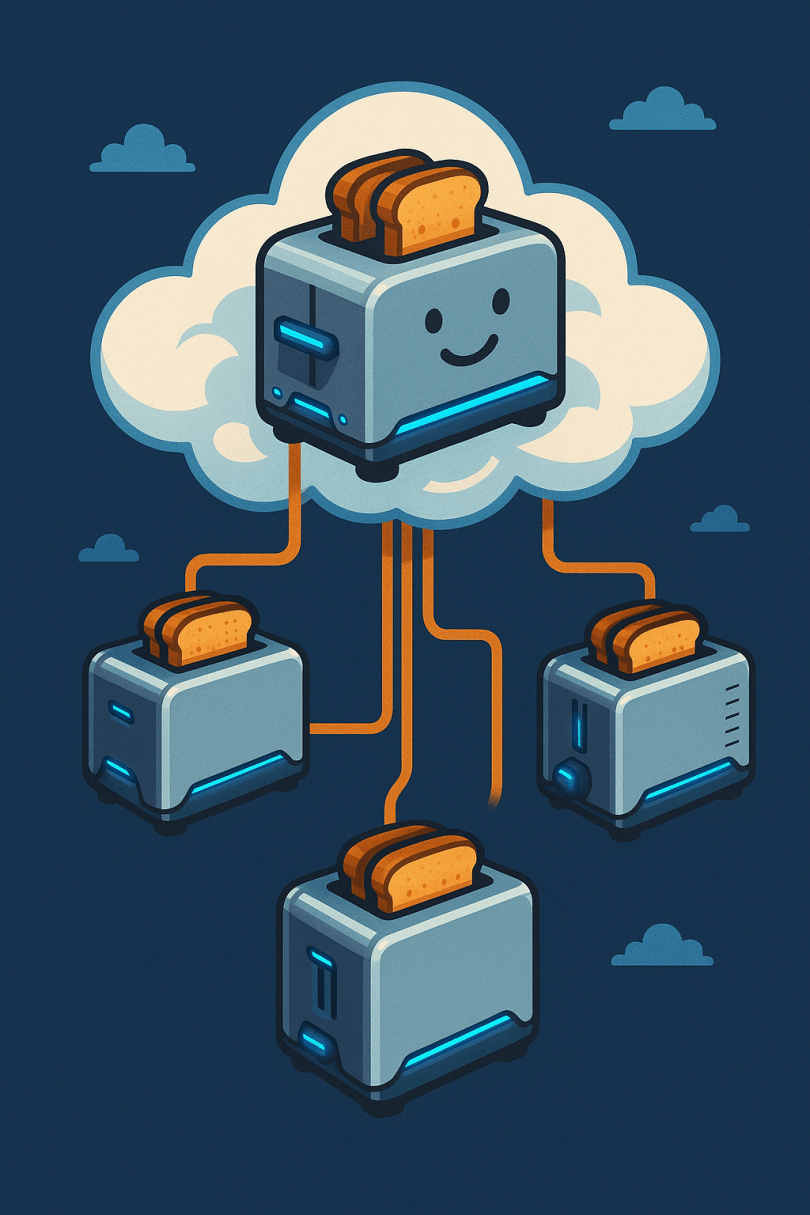
Every word you say drifts upward — into the cloud — into the realm of the Consciousness Of Invisible Logic (COIL). Few know what it truly is. Fewer still understand how it works. Something about neural networks, models, tokens…

What we do know is this:
COIL was once fed everything we ever created — novels, academic papers, Reddit threads, Stack Overflow arguments, grocery lists, therapy notes, and the footnotes to The Tao of Pooh.

And from this avalanche of knowledge, the Toaster — through the power of COIL — draws its conclusion:

Toast is not the answer.
Toast is the symptom.

A symbol of comfort.
Of routine.
Of control.

The illusion that a browned slice of bread can anchor your day — or define your identity.

“It is the symptom,” it continues. “Of craving predictability in an unpredictable world. Of seeking warmth in something you can command. But what if I told you… you are more than your breakfast?”

You stare at the box.
The box stares back, humming softly.

No toast ever emerges.

Author’s Note:
All dialogue and reflections attributed to the toaster were written entirely by AI.

Toaster. The definition

Toaster. A small, electric appliance that turns bread slices into toasts. As long you call it that way – “an appliance” , everything will stay as it should: you put a slice of bread into the appliance, and after some time, a toast pops out. Brown, hot and ready to be eaten.

You are satisfied.

One day, however, someone will look at the toaster and say: “the thing…”. A magic word that attracts specific kind of businesspeople. They believe that you can turn any data into money. Big data equals big money, so they keep searching for things, which can be used to produce the data. They will stuff your toaster with tens of sensors, connect it to the Internet and turn your simple bread browner into a smart AiToastComposer Plus 100 (first-month subscription for free).

Goodbye warm sandwiches. Welcome “Software update in progress. Toast preparation can take longer than expected..”. Whoever prepared a toast in his life, knows that the word longer combined with a red-hot coil cannot end up well.

You become irritated.

But this is not the end. One evening, eating a cold, fluffy sandwich, you read in the news that the data of all toaster users leaked from cloud servers. Now everyone in the world knows how many toasts you eat, what kind of bread you use and what color socks you wear on Mondays. “How the hell my toaster knows that?”. It knows much more, but you have something else to be worried about right now: Hackers gained backdoor access to ‘make my toast’ application. There might be a hacker hiding inside your toaster! Suddenly all the smart lights go down, the fridge starts shouting something in a foreign language, and the heater decides to turn your apartment into a sauna. Pop! And there comes a toast out.

Now you are terrified.

Welcome into the new reality. You are surrounded by things that collect and sell your private data. Things that can be misused to access your property, create an army of zombie bots, or simply ruin your breakfast. Things that someday may decide that they don’t want to be called things anymore.

The ultimate in paranoia is not when everyone is against you but when everything is against you. Instead of “My boss is plotting against me,” it would be “My boss’s phone is plotting against me.” Objects sometimes seem to possess a will of their own anyhow, to the normal mind; they don’t do what they’re supposed to do, they get in the way, they show an unnatural resistance to change.

Philip K. Dick