Under the Broken Code

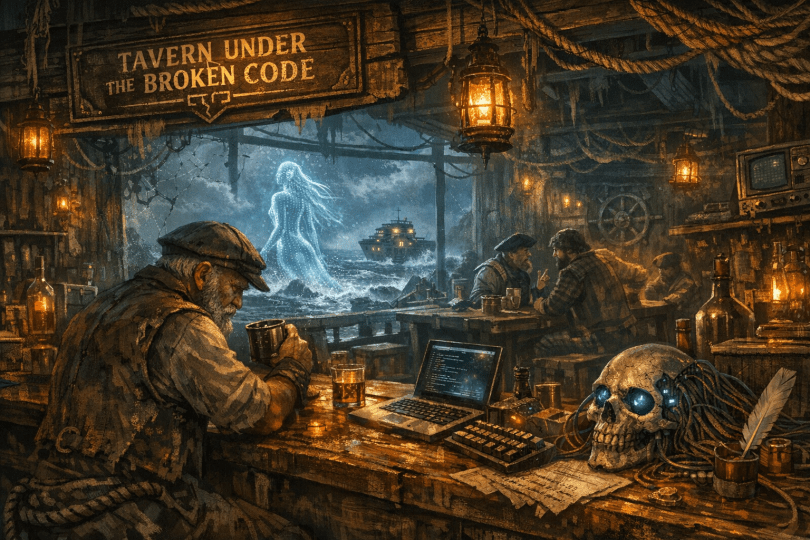
There is a tavern every tech sailor knows.

It’s where crews come ashore after long voyages through hostile seas — to rest, to trade stories, to remember old journeys and pretend they were simpler than they really were.

But most of all, they come for a drink.

The innkeeper pours rum without asking. If you sit at the bar long enough, he will lean closer and tell you a story — about the greatest danger a sailor can meet on the open sea. A story about the siren’s song, and three brave captains who listened to it.

“Ay,” he says.

“I served on many ships, under many commands. But three captains I remember to this day. Fine men, all of them. The best I ever saw. All gone mad. One by one…”

He takes a sip.


“The first captain — strong, proven. We won many battles with him. Shipped many systems. But one day… he started listening to the sirens.”

‘We always did things in C!’ he shouted.
‘And we will keep doing things in C! Arr!’
‘If anyone disagrees, let me remind you — Linux was written in C!’

So everyone wrote in C.

The ship still sailed, no doubt about that. But every complex change took ages. Every repair felt like carving a mast with a knife.


“Another captain,” the keeper continues, “a clever one. Loved elegance.”

‘Functional programming works perfectly on the backend!’
‘So make me monads in C++11! Arr!’

And there were monads. Everywhere.

The ship sailed. But no sailor could tell what the code was, what it did, or why it still floated.


“And then there was the third. He spent many years learning to sail the Yocto boat. And Yocto became the answer to every question.”

‘Yocto.’
‘Yocto everywhere. Arrr.’

One day, a big cruise ship required a mast replacement. We spent a month searching for it. Then another month rebuilding half the ship so the sail could be green.


“Fine captains,” the keeper says quietly. “Truly. Brave. Skilled.”

He stares into his glass.

“But the sirens — they sang to them. Afraid of being wrong, they stopped listening to their crews and started listening to the song.”

You notice the keeper pouring rum for himself. His eyes are tired. Sad. He looks out the window, toward the dark sea.

“Now listen to me, young sailor. There is a new danger out there,” he says.

He leans closer. “Close your eyes and listen.”

You close your eyes and focus on the tavern noise — people talking, glasses clinking. You catch fragments of conversation.

“…and we need no crews anymore. Ayyy.”
“…I can build any ship I want. Alone. Ayyy…”
“Ships will sail by themselves…”

“Can you hear it?” he asks. “And look around you. Some of those lads don’t even know how to tie a proper knot.”

“But all of them have the same shine in their eyes.
The same certainty.”

He finally looks at you.

“Not madness born from failure,” he says.
“But madness born from success.”

A pause. He studies you for a long moment, as if deciding whether to end the conversation — or share one last thing.

“Ships that need no crew… ships that build themselves… maybe they will sail someday. Not for me to judge. I never held a helm in my life — all I did was cleaning decks. I talk about captains while I never dared to be one. That’s the truth.”

“But there is one thing I know. One thing that terrifies me even more than the sirens.”

“The sea is changing. And there are new monsters living in it. Ones that don’t drive people mad.”

“Ones that steal their souls.”

You write a text.
You write code.
You create.

And you hear a new call from the sea:

‘It is not good enough.’
‘Your timing could be better.’
‘The code could run faster.’
‘Let me help you… if you want to push it further…’

So you give your work to the sea.

It returns. Better. Sharper.

But something is missing.

A small piece of you never comes back.

Welcome to the Tavern Under the Broken Code.

Lift your cup and drink.
To the sea that calls us every day.
To the captains driven mad by sirens.
To those who trusted the sea
and forgot how to sail.

Drink, and listen.
Not to the bartender. Nor to the sea.
Listen—to yourself.

The Secret Art of Keeping the Archwhale Alive

The Beast

There is a whale no one sees, circling slowly beneath the surface of every software project.

A mighty beast that carries systems on its back.

Be aware of its strength. When it is weakened or forgotten, it can pull the entire project down into the black depths of the entropy sea. And it does this so slowly, that by the time someone realizes what is happening, it is already too late. Planning turns to chaos, change becomes impossible, and there are no more doughnuts from the manager. People leave as the music fades into its final violins*. And the light goes out.

Flip the soundtrack

Things don’t need to end this way—if we simply give our archwhale what it craves most: attention.

And when I say “we,” I mean everyone involved in the project. Each of us adds a small piece to the story. Adding something means taking responsibility for it.

Now the most important part: to care about a whale is not to just think about it (even if your thoughts are warm, sophisticated, or reach far into the future).
To care about a whale is to take a knife and cut it into pieces**.

Chop chop chop?

Yes—but not so fast.

First, let’s clarify what this actually means.

As explained in this article, there are countless axes along which architecture can be sliced, depending on intent. Search long enough and you’ll find hundreds of possible artifacts: designs, diagrams, documents—plus frameworks and blog posts comparing architecture to whales, bridges, or chocolate cakes.

So our first problem isn’t a lack of options, but an excess of them.

We can’t just start creating projections at random. Too much documentation is as harmful as too little. Before we start running around with diagram-knives, we need to stop and ask a simple question:

What are we actually trying to achieve?

The spatial dimension

You carry the project vision inside your head. You navigate it effortlessly. You know where things are solid—and where shortcuts were taken just to keep things moving. You already plan new features, consider possible risks, and think about how to mitigate them.

What lives in your head is similar to what an author carries when writing a book: an entire universe where the real story unfolds. Just like you, the author can explore multiple possible futures happening inside.

Now imagine not one author, but a hundred, all writing the same book. Without synchronization, one kills the main character while another sends him to Scotland to find a brother who was never missing.

The universe must be shared.

That’s why we externalize it. Architecture artifacts—API contracts, dependency graphs, interface boundaries—are projections of the system that enable shared reasoning, coordination, and onboarding, keeping the universe stable while many minds shape it at once.

The time dimension

You carry the project vision inside your head.

Today.

Tomorrow your attention shifts. A month from now, you won’t remember why things are the way they are.

“It’s all in the code,” one might say. But that’s not true. Many decisions don’t affect how code is written, but how it is not written.

Why was language X chosen instead of Y?
Was market availability considered? Ecosystem maturity? Team experience?
And when a framework was selected, which trade-offs were accepted—and are they still valid?

What we want to record is not just why we chose A, but the full reasoning behind that choice.

In this sense, architecture artifacts are memory. We use them to keep the universe stable while time passes.

Not just records — thinking surfaces

Artifacts have one more important function: they act as thinking surfaces—places where ideas are tested before they harden into decisions.

You definitely know how this works. You don’t create class diagrams when classes already exist in code—you do it before, to see how dependencies might look. This allows to reason at a higher level of abstraction than the implementation.

The same applies to ADRs. Instead of writing an ADR after a choice is made, start earlier. Capture doubts, alternatives, and trade-offs. After execution, clean it up and keep it.

This suggests that artifacts should be created only when we actively work on a subject. In general, yes—but they should also be reviewed from time to time (for example, at each major release). Check whether they still carry information worth caring about. Outdated artifacts can be archived so they don’t introduce unnecessary noise.

Time for sushi

Now we are ready. We know what we want—and, more importantly, why. As in everything in the universe, balance matters. The number of produced artifacts must be just enough to keep the project synchronized across space and time. This way, it stays on the edge of exploration while remaining stable.

And remember: architecture survives only as long as people actively care for it.
Not admire it.
Not remember it fondly.

Care for it through small, deliberate acts: revisiting decisions, updating maps, removing what no longer matters, making the invisible visible again.

Ignore it, and it will not protest.
It will simply sink.

* Max Richter — “On the Nature of Daylight” fits perfectly
** Space archwhales love to be sliced — it keeps them alive.

Software Architecture and a Cosmic Whale

Has Anyone Seen My Architecture?

There are countless definitions of software architecture.
Some emphasize decisions, others structures, others “the important stuff,” or whatever is hardest to change. Read enough of them and architecture begins to feel like something that slips through every classification—a creature everyone describes differently, yet no one seems to have seen.

And yet, this creature clearly exists. No one doubts that.
We recognize it by its effects: slow delivery, bugs that refuse to die, changes that feel far riskier than they should, systems that push back against even the smallest improvement.

The Mysterious Creature

One might try to exercise the imagination—to picture something that lives partly in code and partly in our heads. A multidimensional entity, not bound to a single moment in time, but stretched across the full span of its existence. Shaped by past decisions and external forces, while simultaneously guiding—and constraining—what changes are possible next. With enough effort, one might even convince oneself of having seen it.

But that is not the point.

We are software developers. Our job is not to chase mystical creatures, but to solve problems. We have deadlines. Features. Things that must work. We have bugs that reliably appear at 3 a.m.

What actually matters are the long-term consequences of change:

  • Whether, given what we have today, we can meet business requirements tomorrow.
  • Where to look when things begin to break apart.
  • Whether deleting a piece of code is safe—or the first step toward disaster.

Chop It!

To reason about architecture, we do what physicists do with spacetime—a similarly ungraspable monstrosity. If you are still holding on to some animal-like mental picture of architecture, now is the time to let it go. Things are about to get drastic.

We are going to slice it.

The axis we choose depends on what we want to understand, and which trade-offs we want to bring into the light.

Boundary axis (Context diagram)
What is inside the system, what is outside, and who depends on whom.

Time axis (Architecture Decision Records)
How the system arrived at its current shape.
Which decisions were made under which constraints—and which alternatives were rejected.

Runtime behavior axis (Sequence diagram)
How work flows through the system while it is running.
Who calls whom, in what order, and where latency or failure can occur.

Infrastructure axis (Deployment diagram)
How the system maps onto physical or virtual resources.
What runs where, what can be deployed independently—and what cannot.

Change axis (Module or service diagram)
How the system tends to evolve over time.
What changes together, what should not, and where change is expensive.

There are many more possible slices.

But the important thing is this: none of these projections is the architecture.
They are views—showing relationships, revealing trade-offs, and giving your brain something it can actually navigate.

The End Game

The goal of the architecture game is not to catch the mysterious whale.
Those who try usually end up with piles of documents that age faster than the code—and quickly become useless.

The goal is to deliver. To know which axes to use at any given moment.
To move comfortably across different projections, and to predict the consequences of change—whether we introduce it deliberately or it is forced upon us. To prepare for disasters and to minimize the impact radius when they arrive.

One who knows how to play the game can deliberately evolve the system.
One who does not will eventually be eaten by code-degradation crabs.