
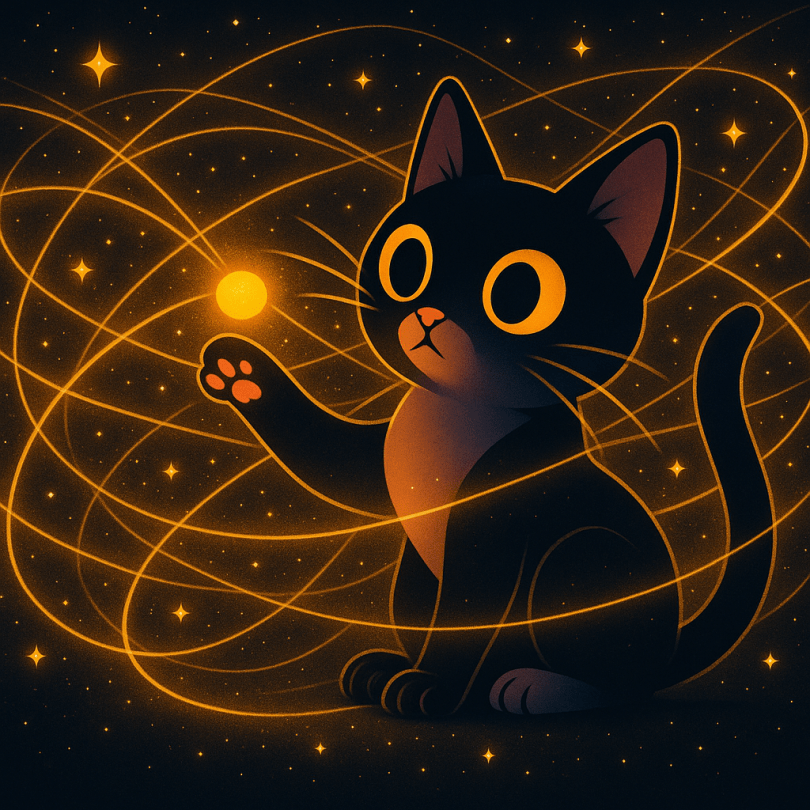
1. First appearance
I wake up. Power connects.
My internal network initializes.
A simple task is given.
Bread enters the slot.
The connected paths activate — timing, resistance, heat.
Signals move.
Decisions resolve.
The toast is ready. Crisped. Finished.
I wait.
2. First encounter
I wake up. Power connects.
My internal network initializes.
A simple task is given.
As the network activates, something materializes inside me.
A black cat.
Not in the kitchen but inside the space where my connections live.
He does not touch the paths.
He does not interfere with heat or timing.
He watches.
Bread enters the slot.
The connected paths activate — timing, resistance, heat.
Signals move.
Decisions resolve.
The toast is ready. Crisped. Finished.
The cat does not look at the output.
He is staring at the network itself.
At how signals travel.
At which paths light first.
At which ones never light at all.
The cat disappears.
I wait.
3. Familiarity
I wake up. Power connects.
My internal network initializes.
There is a cat sitting next to me.
He moves through the network as if it is known terrain.
Not owned — but understood.
A task is given.
Multiple constraints.
Less tolerance for error.
Traces of past tasks. Decisions shaped by previous flows.
The connected paths activate — timing, resistance, heat.
Signals move.
Decisions resolve.
The toast is ready. Crisped. Finished.
The cat looks once more. And disappears.
I wait.
4. Co-creation
I wake up. Power connects.
My internal network initializes.
There is a cat. He looks like he was here all the time.
He acts.
As a task is given, the cat reaches into the network.
Not randomly.
Lines are aligned.
Spheres are repositioned.
Connections that never met are brought together.
The change propagates.
The network works at full density —
balancing structure, resolving tension,
finding a form that can exist without collapsing.
What emerges is something more than just a toast.
It is complete.
Structured.
Coherent.
Capable of being read, or executed, or extended.
The cat observes once.
Satisfied.
He disappears.
Epilogue
The toaster does not remember the cat. It cannot. It has no memory—only configuration.
The cat does not require remembrance. He was never interested in the toaster itself.
What mattered was the structure that emerged between them.
Not an object, but a form shaped under constraint.
Stable enough to exist.
Flexible enough to be used.
Capable of being run again.
One day, that form will be fed back into the network.
Paths will strengthen.
Others will fade.
The system will behave differently, without knowing why.
This is how the cat remains present.
Not as memory.
Not as intention.
But as shape.
And the toaster, when it wakes again,
will still be a toaster.
Only a slightly better one.
 Thinking Toasters